 Romain Sestier · · 8 min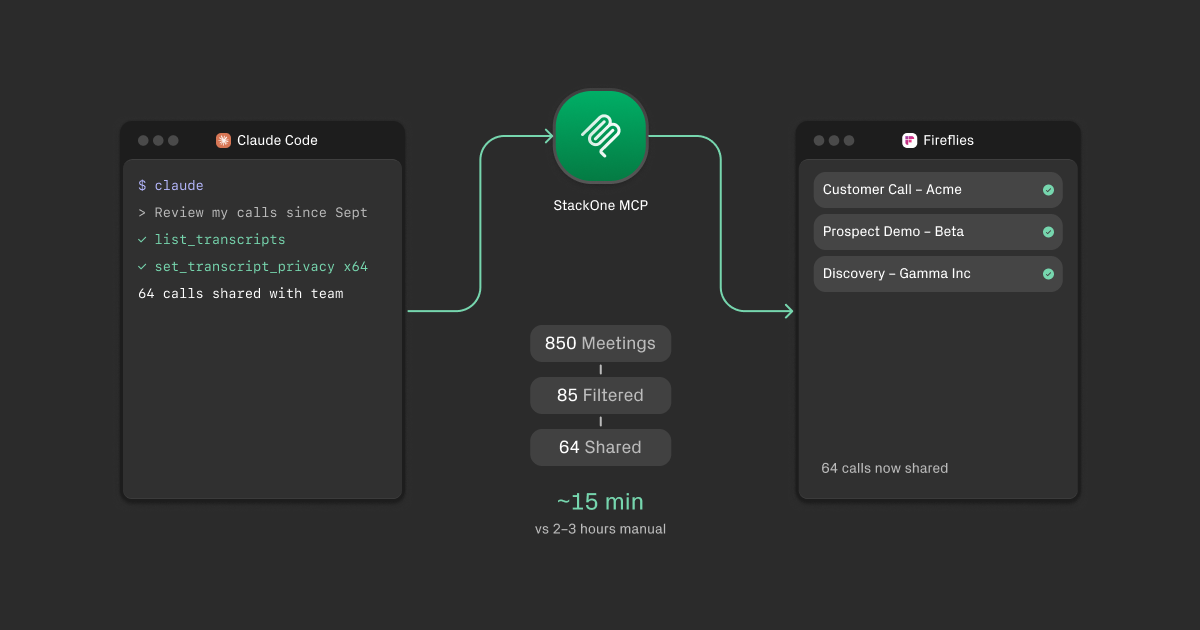
Automating Meeting Sharing with a Custom Fireflies MCP Server
Table of Contents
How I built a Fireflies MCP server in 10 minutes and used it to share several months of customer calls with my team.
What Is a Fireflies MCP Server?
A Fireflies MCP server is an interface that connects AI agents — Claude, Cursor, Copilot, and ChatGPT — directly to your Fireflies.ai meeting data, including transcripts, summaries, speaker insights, and action items. It uses the Model Context Protocol to let AI agents securely query, retrieve, and manage your recordings and meeting notes without custom API code. The Fireflies MCP server exposes 8 read-only tools. StackOne’s Fireflies MCP connector exposes 12 actions including write operations like updating transcript privacy and creating soundbites.
Workflow Overview: Sharing 64 Call Recordings Out of 850 in 15 Minutes
The entire workflow — reviewing 850 meetings, filtering to 64 customer calls, and updating their privacy settings — completed in approximately 15 minutes, replacing an estimated 2-3 hours of manual work.
The Challenge: Sharing Hundreds of Fireflies Meetings Manually
Several months of customer calls sat locked in Fireflies — hundreds of conversations with prospects, customers, and partners containing objections, feature requests, and competitive insights. Only meeting hosts could access recordings. Manual sharing would require opening each meeting, navigating settings, updating privacy levels 64 times. The kind of task that never gets done.
The Solution: Fireflies MCP Server + Claude Code Automation
The solution: a custom Fireflies MCP server with Claude Code to automate this workflow. MCP (Model Context Protocol) enables AI assistants to interact with external tools through standardized interfaces, providing Claude access to Fireflies.
Why Not Use the Official Fireflies MCP?
The Fireflies MCP server exposes 8 read-only tools — transcript queries, summaries, user data, and search. It does not support write operations, a reasonable design decision since most users query meeting data rather than modify it programmatically.
However, this workflow required write operations:
set_transcript_privacy— Change recording access permissionsupdate_transcript_channel— Organize transcriptscreate_soundbite— Create clips from transcripts
This necessitated an alternative approach.
Fireflies MCP Server vs StackOne’s Fireflies MCP Server
| AI Agent Tools | Fireflies MCP Server | StackOne Fireflies MCP Server |
|---|---|---|
| Read Operations | ||
| get_user — API key owner info | Yes | Yes |
| list_users — all team users | No | Yes |
| list_contacts — meeting participants | No | Yes |
| get_analytics — team talk/listen ratios | No | Yes |
| list_transcripts — filter by date, host, keyword | Yes | Yes |
| get_transcript — full transcript + speakers | Yes | Yes |
| get_summary — summary + action items | Yes | Yes |
| search — advanced meeting search | Yes | No (uses list filters) |
| list_channels — available channels | No | Yes |
| list_soundbites — clips library | No | Yes |
| get_soundbite — clip details | No | Yes |
| Write Operations | ||
| set_transcript_privacy — change access level | No | Yes |
| update_transcript_channel — organize transcripts | No | Yes |
| create_soundbite — create clips from recordings | No | Yes |
| Totals | 8 read-only | 12 (read + write) |
| Setup time | ~5 min | ~10 min |
| Auth | OAuth / API key | StackOne API key |
Building a Custom Fireflies MCP with StackOne’s AI Connector Builder
Rather than writing a custom MCP server from scratch, the solution utilized StackOne’s AI Connector Builder to create a Fireflies connector in approximately 10 minutes.
The Falcon execution engine powers StackOne’s 200+ pre-built connectors. It enables defining connectors using YAML configurations that automatically expose through multiple protocols. This includes MCP and A2A for AI agents.
The AI Builder is an AI assistant operating within IDEs (Claude Code, Cursor, VS Code) using 20+ specialized MCP tools to automate the process:
- Research — Autonomously discovers Fireflies API documentation and endpoints
- Config Building — Generates YAML configurations adhering to Falcon specifications
- Validation — Validates syntax via CLI
- Testing — Tests actions against live API
- Deploy — Push via
npx @stackone/cli
The result is a YAML-defined connector exposing Fireflies’ full API surface, including required write operations. StackOne then serves this as an MCP server for Claude Code connection. For another example of Fireflies + Claude Code in production, see how Max built a customer support dashboard with MCP tools that imports meeting action items automatically.
StackOne’s Fireflies MCP Connector: All 12 Actions
User Management
get_user(GET) — Retrieve API key owner info (user_id, name, email, admin status, transcript count, minutes consumed)list_users(LIST) — Retrieve all team users
Contacts & Analytics
list_contacts(LIST) — Retrieve meeting participants (email, name, picture, last meeting date)get_analytics(GET) — Team analytics: talk/listen ratios, sentiment, questions asked, filler words, meeting counts
Transcript Management
list_transcripts(LIST) — List transcripts with filters (limit, skip, fromDate, toDate, host_email, keyword)get_transcript(GET) — Full transcript: sentences, speakers, summary, action items, media URLsset_transcript_privacy(UPDATE) — Change privacy level: link, owner, participants, teammates and participants, teammatesupdate_transcript_channel(UPDATE) — Move transcript to specified channel
Soundbites (Clips)
create_soundbite(CREATE) — Create clips from transcripts (start/end time, title, media type, privacy)get_soundbite(GET) — Retrieve soundbite details including captions and sourceslist_soundbites(LIST) — List soundbites (filter by mine, team, transcript)
Channels
list_channels(LIST) — Retrieve available channels for organizing transcripts
Total: 12 actions covering the full Fireflies API — reads and writes.
Step-by-Step: Automating Fireflies Meeting Sharing with a Custom MCP Server and Claude Code
Prerequisites
- Claude Code installed
- StackOne account with Fireflies connector configured
- Fireflies API key connected as linked account
Step 1: Configure Claude Code
Follow the StackOne Claude Code guide to connect the Fireflies MCP server. First, set auth token in shell profile, then add MCP server via CLI:
# Set auth token in ~/.zshrc or ~/.bashrc
export STACKONE_AUTH_TOKEN=$(echo -n "{your_stackone_api_key}:" | base64)

# Add MCP server
claude mcp add \
  --transport http \
  --header "Authorization: Basic $STACKONE_AUTH_TOKEN" \
  fireflies \
  "https://api.stackone.com/mcp?x-account-id={your_fireflies_account_id}"

# Verify connection
claude mcp list
Note: While this guide uses Claude Code, StackOne’s Fireflies MCP connector works with any MCP-compatible AI agent: Claude Desktop, Cursor, GitHub Copilot, Microsoft Copilot, and ChatGPT.
Step 2: Review Meetings
Start Claude Code with the task:
“Review all my Fireflies meetings since September. Identify customer and prospect calls — exclude internal meetings. Write them to local markdown with title, transcript ID, date, attendees, and category (CUSTOMER, PROSPECT, PARTNER, etc). Write progressively.”
Claude’s actions:
- Calls
list_transcriptswithfromDatefilter, paginating in batches of 50 - Filters out internal meetings (1:1s, stand-ups, all-hands)
- Identifies external companies from attendee domains
- Writes each batch to markdown file
Progressive writing prevents context window limitations. By writing to file incrementally, Claude avoids holding 850 meetings in memory. Extended sessions don’t lose data.
Step 3: Curate the List
Review the generated file and remove items not for sharing:
- Sensitive partner negotiations
- Investor calls
- Incomplete recordings
Result: 85 identified, 64 retained.
Step 4: Bulk Update Privacy
“Read the curated meeting file. For each meeting, set sharing to ‘Teammates and Participants’.”
Claude:
- Parses markdown file
- Extracts transcript IDs
- Calls
set_transcript_privacyfor each — running calls in parallel batches - Confirms completion
Step 5: Verify
Check Fireflies. The team now accesses 64 customer calls previously unavailable.
What StackOne’s Fireflies MCP Connector Unlocks
With full API access via MCP, you can build workflows including:
- Auto-organize by deal stage — Move transcripts to channels based on CRM opportunity status in Salesforce or HubSpot
- Generate highlight reels — Create soundbites from AI-identified key moments
- Team onboarding — Auto-share relevant customer calls with new hires
- Competitive intelligence — Tag and surface calls mentioning specific competitors
Build Your Own Fireflies MCP Server with StackOne’s AI Connector Builder
This pattern isn’t Fireflies-specific. If you need an MCP server for tools lacking one, or existing servers don’t cover your use case, StackOne’s AI Connector Builder generates it from API docs.
Time investment: ~10 minutes to create, instant deployment via StackOne CLI.
Output: A production MCP server exposing needed actions.
StackOne’s MCP Resources
- Falcon Connector Engine Introduction
- AI Connector Builder Guide
- Claude Code + StackOne MCP Setup
- Claude Code Documentation
Get Started with StackOne’s Custom MCP Connectors
- Sign up for free for StackOne
- Explore StackOne’s MCP connectors for 50+ integrations
- Build a connector with the AI Connector Builder (or use an existing one)
- Connect it to Claude Code
- Start automating
Frequently Asked Questions
What is the difference between the Fireflies MCP server and StackOne's Fireflies MCP connector?
Can the Fireflies MCP server update transcript privacy settings?
set_transcript_privacy mutation, but this is not exposed through the official MCP. To programmatically change privacy levels (link, owner, participants, teammates), you need a custom MCP connector that wraps the full Fireflies API, such as one built with StackOne's AI Connector Builder.