 Matt Carey · · 5 min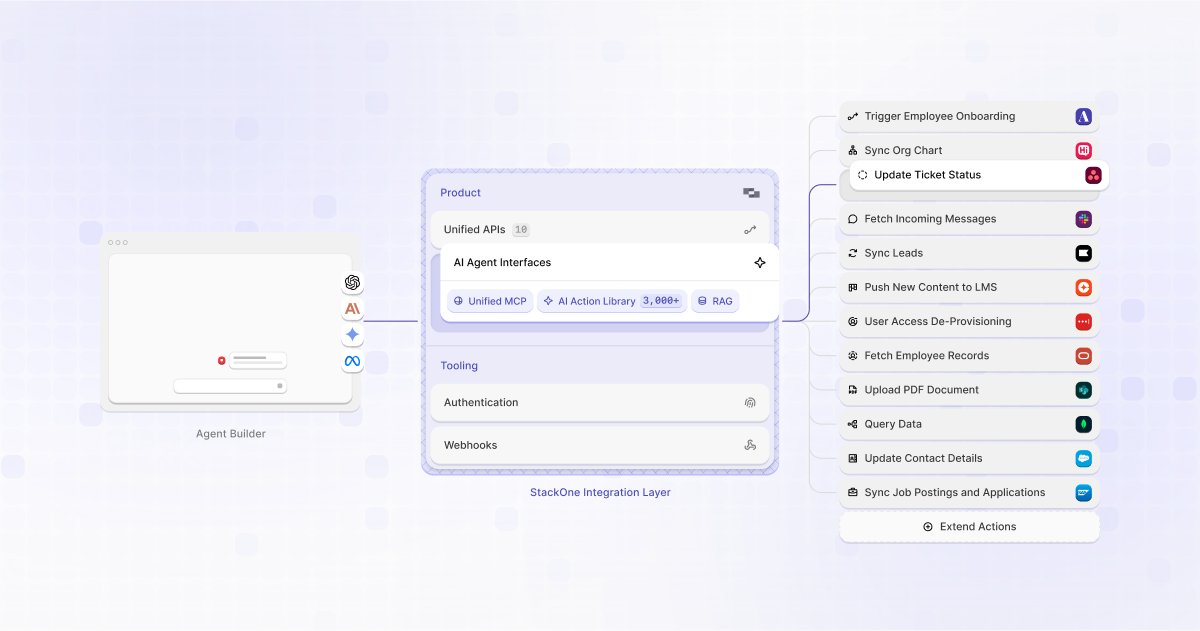
Bring AI Agents to Work with StackOne
Table of Contents
At Cloudflare Connect 2025 in London, I discussed how StackOne is evolving to empower the next generation of AI agents in the enterprise. What began as addressing B2B SaaS integration challenges has transformed into building infrastructure for AI agents that can perform meaningful actions in real-world settings.
The IMF projects AI will boost global GDP by 0.5% annually from 2025-2030, and enterprise customers are embracing this transformation. Enterprise spending on generative AI surged sixfold in 2024 to nearly $14 billion, with 62% of organizations projecting AI agent ROI exceeding 100%, averaging 171% returns. However, despite advanced AI models like Claude 4.1 and GPT-5 becoming remarkably intelligent, they remain unable to interact effectively with most enterprise software.
StackOne makes AI agents perform “actions” reliably, bridging the gap between intelligent systems and thousands of B2B SaaS applications that run modern businesses.
Integrations, Integrations, Integrations
StackOne was founded to solve a fundamental problem: companies need connecting with hundreds of disparate APIs for HR, compliance, and CRM functions. Each integration traditionally required custom code, unique authentication flows, and constant maintenance — an N x M problem consuming engineering resources across industries.
The solution was an integration layer offering pre-mapped connections to over 250 SaaS platforms through a common data schema. Whether pulling employee data from Workday, SAP, or BambooHR, users receive the same clean, structured response.
Building with AI, For AI
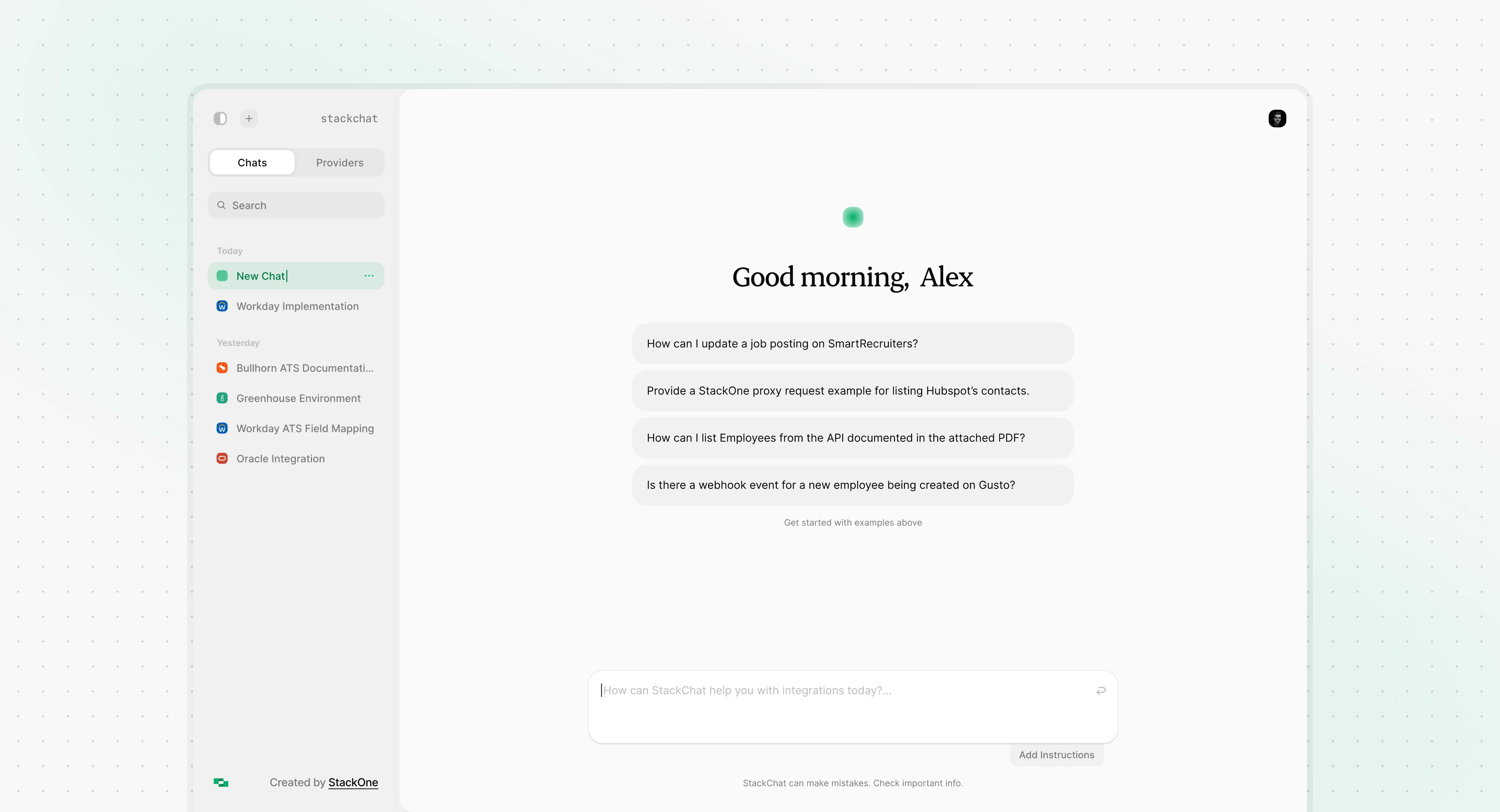
From inception, StackOne used AI internally to accelerate integration-building capabilities. By developing a sophisticated RAG system that scrapes, chunks, and indexes API documentation, the internal “StackChat” tool allows engineers to quickly query and understand various APIs. The result: building 70-90 integrations per quarter — far outpacing larger competitors.
The Agentic Revolution
As 2024 progressed, teams increasingly used StackOne to build AI agents for HR, virtual recruiters, personal assistants, and beyond. This surge exposed critical challenges traditional APIs weren’t designed to handle.
Context Window
Traditional OpenAPI specifications prove poorly suited for AI agents. Retrieving basic employee data from Workday’s native API requires approximately 17,000 tokens — far exceeding practical reasoning limits of most models. StackOne’s normalized employee object delivers identical information in just 600 tokens.
Context window is a scam. Even models claiming 2 million token context windows struggle with coherent reasoning well before that threshold. We documented the six failure patterns that cause agents to exceed their context limits.
Authentication
Managing authentication across multiple services for AI agents presents significant burdens. OAuth flows, token refreshes, API key management — these complexities multiply when giving agents access to an entire SaaS stack.
Tool Calling Problem
Traditional SDKs and APIs weren’t designed for AI agents, forcing engineers to hard-code API calls into tools, hack together custom OpenAPI-to-tool converters, or rely on nascent MCP servers.
Supporting Developers at Every Turn
StackOne has evolved to become the integration layer enabling Agentic B2B SaaS. The strategy supports developers wherever they are in their AI agent journey, with whatever tools they prefer.
1. StackOne ToolSet
StackOne ToolSet is our answer to agent integration challenges — an open-source SDK tailor-made for AI agent development, available in TypeScript and Python. Key features include:
- Tool Filtering: Developers easily filter which endpoints expose to agents using simple glob patterns
- Framework Integration: Compatibility with OpenAI’s function calling, LangChain, CrewAI, Pydantic AI, and AI SDK
- Managed Context: The SDK handles StackOne-specific context like Account IDs and API keys behind the scenes
2. Traditional SDKs and REST APIs
Not every use case requires AI-specific tooling. Comprehensive SDKs in multiple languages, along with REST APIs, give developers full control when building traditional integrations or implementing custom logic around agent interactions.
3. Model Context Protocol (MCP)
When Anthropic announced MCP in November 2024, the initial reaction was existential: “Is our company dead?” We quickly realized MCP is just another standard — one we’re uniquely positioned to support.
StackOne engineers are early MCP adopters for personal productivity. We identified opportunities extending MCP’s usefulness to company level. Similar to StackChat, we’ve been dogfooding a platform internally enabling employees to create, share, and customize AI integrations powered by MCP. This platform, called Disco, will be discussed soon.
It Actually Works
Our exploratory approach’s impact is already visible. During the Cloudflare Connect demo, I showed an AI chat agent performing complete onboarding: retrieving applicant data from Greenhouse, identifying the latest hire, and creating new employee records in Workday — all orchestrated through ToolSet SDK. This cross-system automation would have taken days to manually coordinate but now requires minutes with agents plus tools.
Looking Ahead
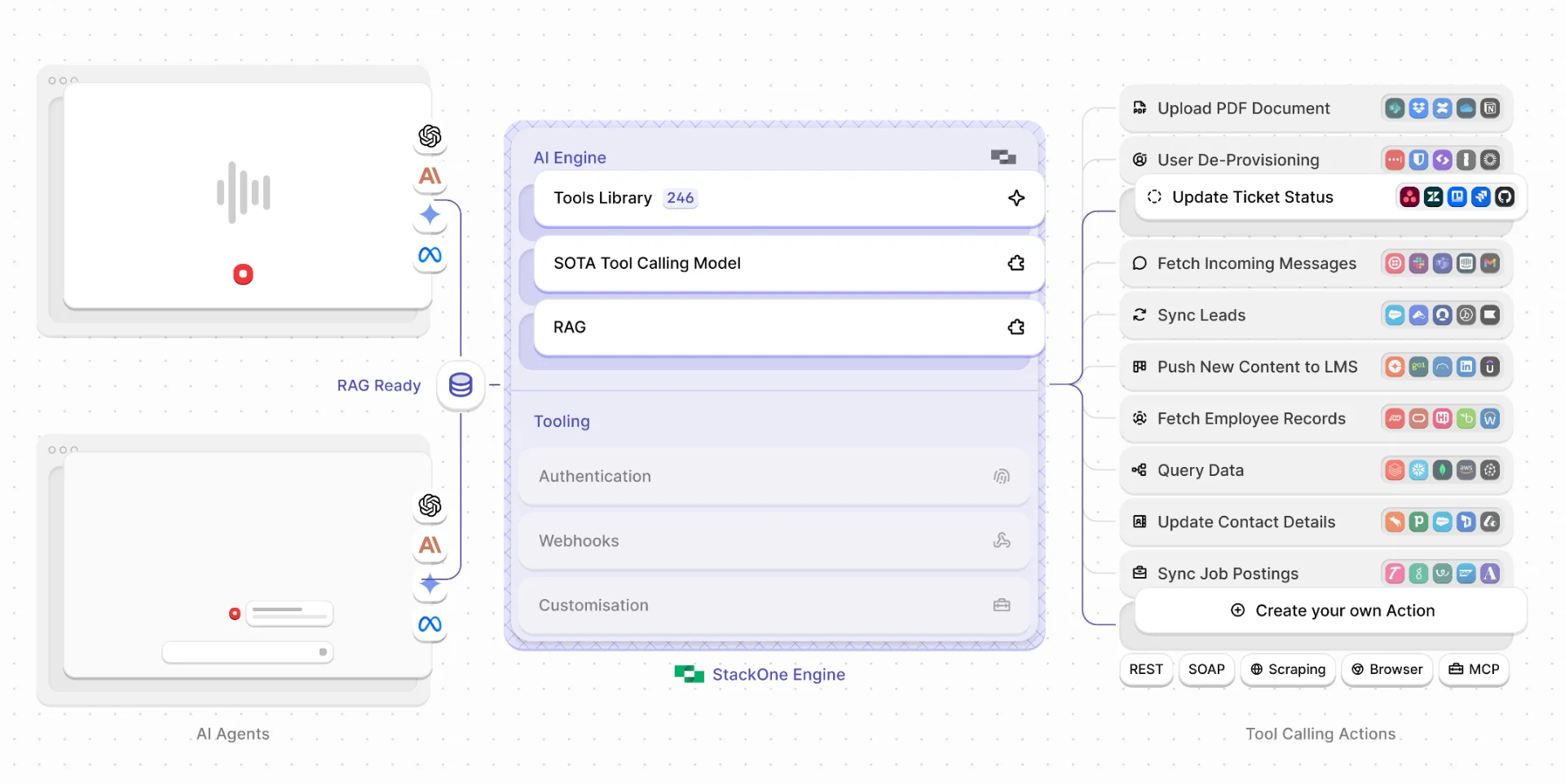
Our roadmap is ambitious:
- Comprehensive Coverage: Achieving complete integration coverage across all interfaces (REST, SOAP, Scraping, Browser, and MCP)
- Reliability First: Building tools that work, even when underlying APIs are flawed
- Intelligent Planning: Developing state-of-the-art AI planning models for smarter tool calling
- Enterprise Options: Exploring self-hostable solutions for maximum security and control
The Bigger Picture
AI agents dominate current conversations. These agents need interacting with tools humans use — Salesforce for CRM, Workday for HR, Slack for communication, Jira for project management. That’s thousands of different systems, each with their own APIs, authentication methods, and data formats.
Providing integration layers that abstract complexity doesn’t just ease developers’ lives — it accelerates the entire AI agent ecosystem. Whether building next-generation AI assistants or augmenting workforces with intelligent automation, StackOne provides critical infrastructure.
Join Us
As StackOne evolves from integration platform to essential B2B AI agent infrastructure, we’re seeking talented individuals to join our mission. We’re hiring AI Engineers (including what might be the world’s first dedicated MCP Engineer role) and other talent.
Link to recording: https://www.youtube.com/watch?v=xttDaO0pgl4