Connect
Optimize
Secure
Announcing StackOne Defender: leading open-source prompt injection guard for your agent • Read More →
Production-ready X (Twitter) MCP server with 55 extensible actions — plus built-in authentication, security, and optimized execution.
 StackOne
Coverage
Create, read, update, and delete across X (Twitter) — and extend your agent's capabilities with custom actions.

Authentication
Per-user OAuth in one call. Your X (Twitter) MCP server gets session-scoped tokens with zero credentials stored on your infra.
Agent Auth →
Security
Every X (Twitter) tool response scanned for prompt injection in milliseconds — 88.7% accuracy, all running on CPU.
Prompt Injection Defense →
Performance
Free up to 96% of your agent's context window to enhance reasoning and reduce cost, on every X (Twitter) call.
Tools Discovery →A X (Twitter) MCP server lets AI agents read and write X (Twitter) data through the Model Context Protocol — Anthropic's open standard for connecting LLMs to external tools. StackOne's X (Twitter) MCP server ships with 55 pre-built actions, fully extensible via the Connector Builder — plus managed authentication, prompt injection defense, and optimized agent context. Connect it from MCP clients like Claude Desktop, Cursor, and VS Code, or from agent frameworks like OpenAI Agents SDK, LangChain, and Vercel AI SDK.
Every action from X (Twitter)'s API, ready for your agent. Create, read, update, and delete — scoped to exactly what you need.
Create a new tweet on behalf of the authenticated user.
Retrieve a single tweet by its ID.
Retrieve tweets from members of a specific list.
Delete a tweet posted by the authenticated user.
Add a user to a list owned by the authenticated user.
Retrieve users who are members of a specific list.
Remove a user from a list owned by the authenticated user.
Retrieve a single X Space by its ID.
Search for X Spaces by keyword.
Bookmark a tweet for the authenticated user.
Retrieve bookmarked tweets for the authenticated user.
Remove a tweet from the authenticated user's bookmarks.
Send a direct message to an existing conversation.
Create a new group DM conversation and send an initial message.
Send a direct message to a specific user, creating a new 1-on-1 conversation if one does not exist.
Create a new X list on behalf of the authenticated user.
Search for tweets from the past 7 days matching a query.
Retrieve tweets posted by a specific user.
Retrieve tweets mentioning a specific user.
Retrieve the authenticated user's reverse chronological home timeline.
Retrieve users who retweeted a specific tweet.
Retrieve tweets that quote a specific tweet.
Get the count of tweets matching a search query over the past 7 days.
Returns the authenticated user's profile information.
Retrieve a user's profile by their unique ID.
Retrieve a user's profile by their @username.
Retrieve a list of users who follow a specific user.
Retrieve a list of users that a specific user follows.
Retrieve users muted by the authenticated user.
Retrieve users blocked by the authenticated user.
Retrieve direct message events for the authenticated user.
Retrieve events from a specific direct message conversation.
Retrieve a single X list by its ID.
Retrieve lists owned by a specific user.
Retrieve lists that a user is a member of.
Retrieve lists pinned by the authenticated user.
Retrieve live or scheduled Spaces created by specific users.
Retrieve tweets liked by a specific user.
Retrieve users who liked a specific tweet.
Retrieve trending topics for a specific location by WOEID.
Update a list's name, description, or privacy setting.
Delete a list owned by the authenticated user.
Retweet a tweet on behalf of the authenticated user.
Remove a retweet made by the authenticated user.
Hide a reply to one of the authenticated user's tweets.
Follow another user on behalf of the authenticated user.
Unfollow a user on behalf of the authenticated user.
Mute a user on behalf of the authenticated user.
Remove a mute on behalf of the authenticated user.
Block a user on behalf of the authenticated user.
Remove a block on behalf of the authenticated user.
Pin a list to the authenticated user's account.
Unpin a list from the authenticated user's account.
Like a tweet on behalf of the authenticated user.
Remove a like from a tweet on behalf of the authenticated user.
One endpoint. Any framework. Your agent is talking to X (Twitter) in under 10 lines of code.
MCP Clients
Agent Frameworks

 JSON
JSON{
"mcpServers": {
"stackone": {
"command": "npx",
"args": [
"-y",
"mcp-remote@latest",
"https://api.stackone.com/mcp?x-account-id=<account_id>",
"--header",
"Authorization: Basic <YOUR_BASE64_TOKEN>"
]
}
}
}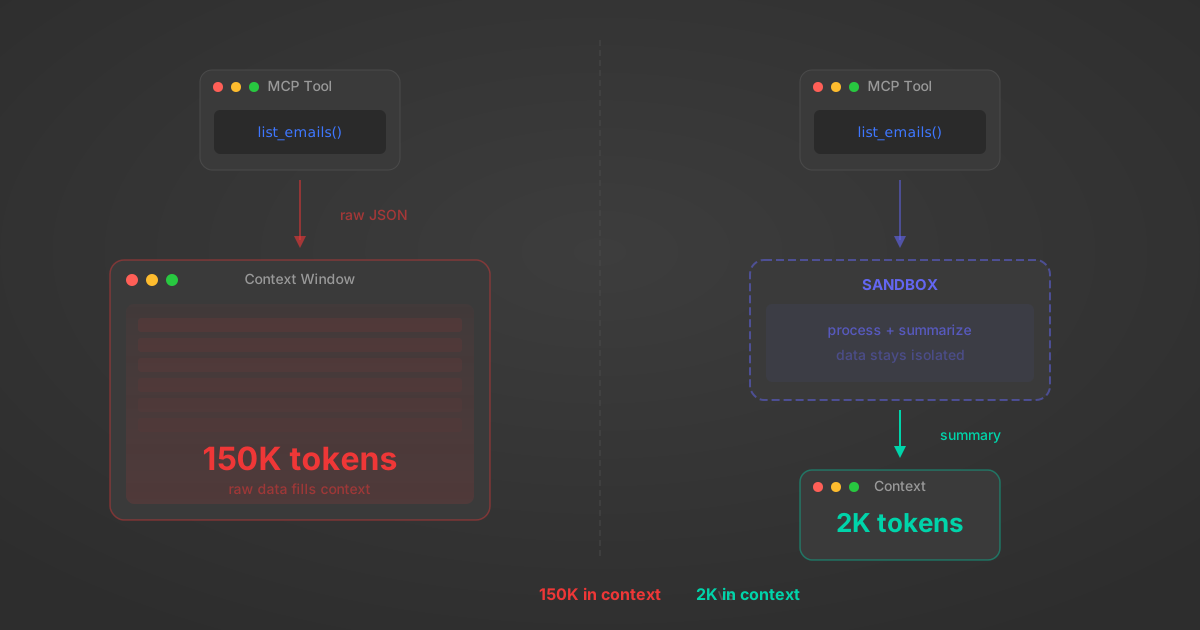
Anthropic's code_execution processes data already in context. Custom MCP code mode keeps raw tool responses in a sandbox. 14K tokens vs 500.
11 min
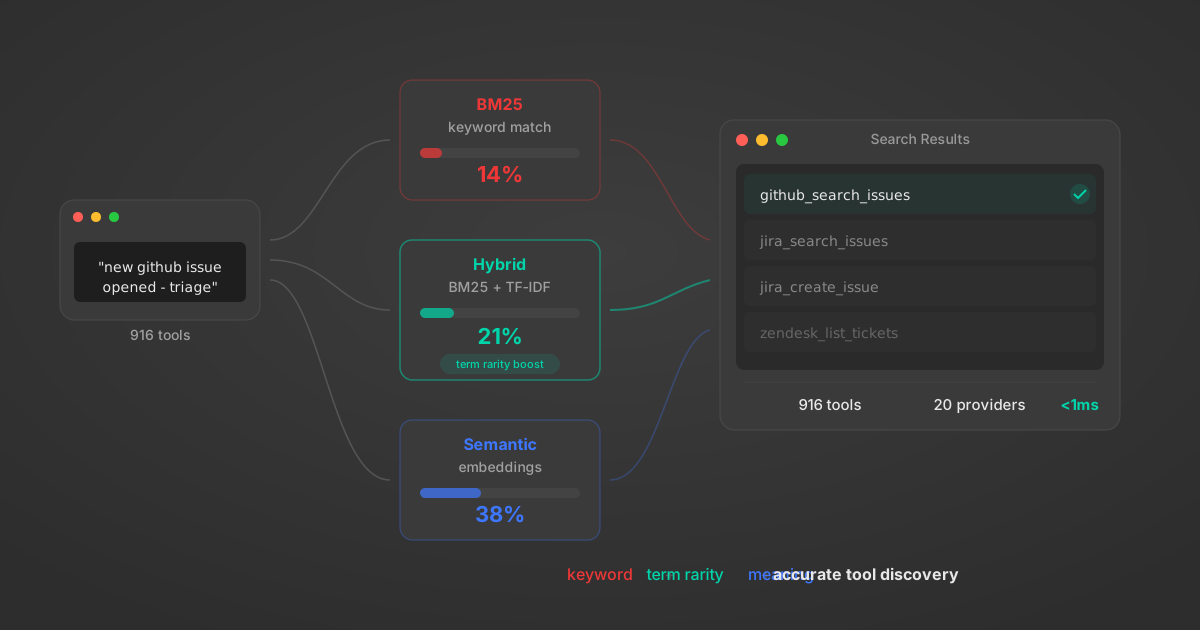
Benchmarking BM25, TF-IDF, and hybrid search for MCP tool discovery across 916 tools. The 80/20 TF-IDF/BM25 hybrid hits 21% Top-1 accuracy in under 1ms.
10 min
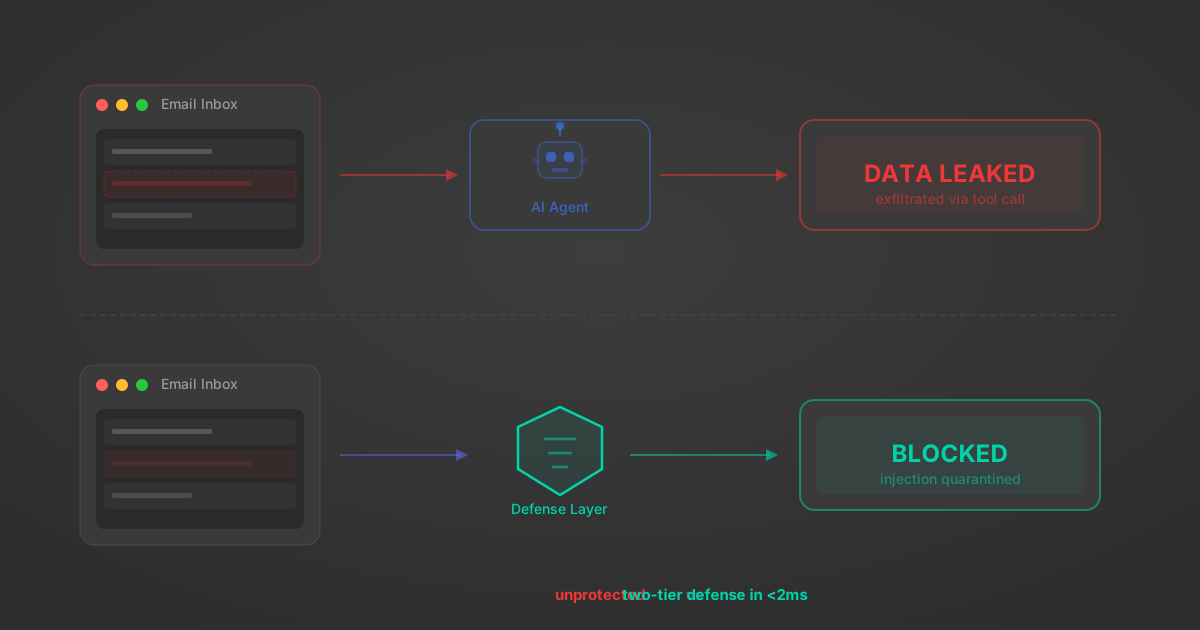
MCP tools that read emails, CRM records, and tickets are indirect prompt injection vectors. Here's how we built a two-tier defense that scans tool results in ~11ms.
12 min
origin_owner_id.All the tools you need to build and scale AI agent integrations, with best-in-class connectivity, execution, and security.