Connect
Optimize
Secure
Announcing StackOne Defender: leading open-source prompt injection guard for your agent • Read More →
Production-ready Cloudflare MCP server with 137 extensible actions — plus built-in authentication, security, and optimized execution.
 StackOne
Coverage
Create, read, update, and delete across Cloudflare — and extend your agent's capabilities with custom actions.

Authentication
Per-user OAuth in one call. Your Cloudflare MCP server gets session-scoped tokens with zero credentials stored on your infra.
Agent Auth →
Security
Every Cloudflare tool response scanned for prompt injection in milliseconds — 88.7% accuracy, all running on CPU.
Prompt Injection Defense →
Performance
Free up to 96% of your agent's context window to enhance reasoning and reduce cost, on every Cloudflare call.
Tools Discovery →A Cloudflare MCP server lets AI agents read and write Cloudflare data through the Model Context Protocol — Anthropic's open standard for connecting LLMs to external tools. StackOne's Cloudflare MCP server ships with 137 pre-built actions, fully extensible via the Connector Builder — plus managed authentication, prompt injection defense, and optimized agent context. Connect it from MCP clients like Claude Desktop, Cursor, and VS Code, or from agent frameworks like OpenAI Agents SDK, LangChain, and Vercel AI SDK.
Every action from Cloudflare's API, ready for your agent. Create, read, update, and delete — scoped to exactly what you need.
List all accounts you have ownership or verified access to.
Retrieve details for a specific Cloudflare account by ID.
Create a new AI Gateway for proxying and monitoring AI API calls.
List all AI Gateway configurations in the account.
Retrieve details for a specific AI Gateway including configuration and usage statistics.
Update an AI Gateway's configuration including caching, rate limiting, and logging settings.
Delete an AI Gateway and all its configuration.
Create a new custom hostname for a zone with SSL configuration for SaaS customer domains.
List all custom hostnames for a zone with optional filtering by hostname, SSL status, and order.
Retrieve details for a specific custom hostname including SSL status and ownership verification.
Update a custom hostname's SSL settings, origin server, or other configuration.
Delete a custom hostname and its associated SSL certificate.
Create a new D1 SQL database.
List all D1 SQL databases in the account.
Retrieve details for a specific D1 database by UUID.
Execute a SQL query against a D1 database with optional parameter binding.
Delete a D1 database by UUID.
Create a new DNS record for a zone with type, name, content, TTL, and proxy settings.
List all DNS records for a zone with optional filtering by type, name, and content.
Retrieve details for a specific DNS record by zone ID and record ID.
Overwrite an existing DNS record with new values for type, name, content, TTL, and proxy settings.
Delete a DNS record from a zone.
List all rulesets at the zone level for WAF and other security features.
Retrieve a specific ruleset with all its rules.
Delete a zone-level ruleset and all its versions.
Create an IP access rule to block, challenge, or allow traffic based on IP, IP range, country, or ASN.
List IP access rules for the account that control access based on IP address, IP range, country, or ASN.
Delete an IP access rule by ID.
Create a standalone healthcheck to monitor an origin server's availability via HTTP, HTTPS, or TCP.
List all standalone healthchecks for a zone to monitor origin server availability.
Retrieve details for a specific healthcheck including its status, configuration, and failure reason.
Update a healthcheck's configuration including address, check interval, expected responses, and suspension status.
Delete a standalone healthcheck from a zone.
Create a new Workers KV namespace in the account.
List all Workers KV namespaces in the account.
Retrieve details for a specific KV namespace by ID.
Delete a KV namespace and all its keys.
Read the value for a specific key in a KV namespace.
Delete a key-value pair from a KV namespace.
List all load balancers for a zone.
Retrieve details for a specific load balancer.
Delete a load balancer by ID.
List all load balancer pools in the account.
Retrieve details for a specific load balancer pool.
List all load balancer monitors in the account.
Retrieve details for a specific load balancer monitor.
Create a new Logpush job to deliver logs from a dataset to an external destination.
List all Logpush jobs configured for a zone for log delivery to external destinations.
Retrieve details for a specific Logpush job including dataset, destination, and status.
Update an existing Logpush job's configuration including destination, fields, filters, and enabled status.
Delete a Logpush job to stop log delivery to the configured destination.
List all members of a Cloudflare account with their roles and status.
Retrieve details for a specific account member.
Remove a member from the Cloudflare account.
Create a new Cloudflare Pages project.
List all Cloudflare Pages projects in the account.
Retrieve details for a specific Pages project by name.
Delete a Pages project by name.
List all deployments for a Pages project.
Retrieve details for a specific Pages deployment.
Create a new R2 storage bucket.
List all R2 storage buckets in the account.
Retrieve details for a specific R2 bucket by name.
Delete an R2 bucket by name.
Create a new rules list for use in firewall rules and security features.
List all rules lists (IP lists, hostname lists, etc.) in the account.
Retrieve details for a specific rules list by ID.
Delete a rules list by ID.
Retrieve details for a specific SSL/TLS certificate pack including status, hostnames, and expiration.
Delete an Advanced Certificate Manager certificate pack.
Retrieve the Universal SSL settings for a zone including whether it is enabled.
Enable or disable Universal SSL for a zone.
Create a new Cloudflare Tunnel for securely connecting origin servers to the Cloudflare network.
List all Cloudflare Tunnels in the account for securely exposing applications without opening inbound ports.
Retrieve details for a specific Cloudflare Tunnel including status, connections, and configuration.
Delete a Cloudflare Tunnel. The tunnel must have no active connections before deletion.
Create a new waiting room for a zone to manage traffic surges and protect origin servers.
List all waiting rooms configured for a zone for managing traffic surges.
Retrieve details for a specific waiting room including its configuration and queue settings.
Update a waiting room's configuration including capacity limits, queue settings, and session duration.
Delete a waiting room from a zone.
List all Workers scripts deployed to the account.
Delete a Workers script by name.
Create a Workers route to map a URL pattern to a Workers script.
List all Workers routes for a zone.
Delete a Workers route by ID.
List all builds for a Workers script to track deployment pipeline history.
Retrieve details for a specific Workers build including status and metadata.
List all cron triggers (scheduled executions) for a Workers script.
Replace all cron triggers for a Workers script with a new set of schedules.
List all secret bindings for a Workers script (names only, values are not returned).
Delete a secret binding from a Workers script.
Add a new zone (domain) to the Cloudflare account.
List all zones (domains) in the account with optional filtering by name, status, and pagination.
Retrieve details for a specific zone by ID.
Remove a zone (domain) from Cloudflare.
List all settings for a zone including SSL mode, security level, caching, and more.
Retrieve the value of a specific zone setting by its ID.
Update the value of a specific zone setting such as SSL mode, security level, or caching.
List request/response logs for an AI Gateway with filtering by model, provider, date range, and status.
Retrieve DNS analytics data for a zone including query volume, response codes, and record types over time.
Retrieve DNS analytics data grouped by time intervals for visualizing query trends over time.
List all firewall rules for a zone.
List all rulesets at the account level.
List all keys in a KV namespace with optional prefix filtering and pagination.
Retrieve the health status of a load balancer pool and its origins.
List all available roles for the Cloudflare account.
List audit log events for the account showing who made changes and when.
Get a summary of Layer 3 DDoS attack activity including top protocols and attack vectors.
Get a summary of Layer 7 application-layer attack activity including HTTP methods and mitigation techniques.
Get internet traffic anomalies detected by Cloudflare Radar for monitoring outages and disruptions.
Retrieve the results of a URL scan including threat verdicts, page details, and detected technologies.
Search previously submitted URL scans with filters for hostname, path, and date range.
Get Cloudflare Radar domain popularity ranking for a specific domain.
Get the top ranked domains globally or by location from Cloudflare Radar.
Get BGP hijack events detected by Cloudflare Radar for monitoring routing security.
Get BGP route leak events detected by Cloudflare Radar for monitoring routing integrity.
Look up IP address information including ASN, geolocation, and network details from Cloudflare Radar.
Look up ASN (Autonomous System Number) information including organization, country, and network size.
List all items in a rules list with pagination.
List all SSL/TLS certificate packs for a zone including Universal, Advanced, and custom certificates.
Get the SSL verification status and validation records for a zone's certificate pack.
List active connections (cloudflared connectors) for a specific Cloudflare Tunnel.
Retrieve the configuration for a remotely-managed Cloudflare Tunnel including ingress rules.
Get the real-time status of a waiting room including queue length, estimated wait time, and active users.
Retrieve settings and metadata for a specific Workers script.
Retrieve build logs for a specific Workers build to diagnose build failures or review output.
Execute a saved Workers observability query to retrieve logs, errors, and invocation events.
Retrieve available telemetry keys (filterable fields) for Workers observability queries.
Retrieve distinct values for a specific telemetry key to understand available filter options.
Verify that the API token is valid and active.
Rename an existing KV namespace.
Write multiple key-value pairs to a KV namespace in a single request with optional expiration settings.
Submit a URL for scanning by Cloudflare Radar to analyze for phishing, malware, and other threats.
Order an Advanced Certificate Manager certificate pack for specific hostnames.
Create or update a secret binding for a Workers script.
Purge cached content for a zone. Purge everything or specific files/tags/hosts.
One endpoint. Any framework. Your agent is talking to Cloudflare in under 10 lines of code.
MCP Clients
Agent Frameworks

 JSON
JSON{
"mcpServers": {
"stackone": {
"command": "npx",
"args": [
"-y",
"mcp-remote@latest",
"https://api.stackone.com/mcp?x-account-id=<account_id>",
"--header",
"Authorization: Basic <YOUR_BASE64_TOKEN>"
]
}
}
}172+ actions
134+ actions
128+ actions
125+ actions
118+ actions
109+ actions
85+ actions
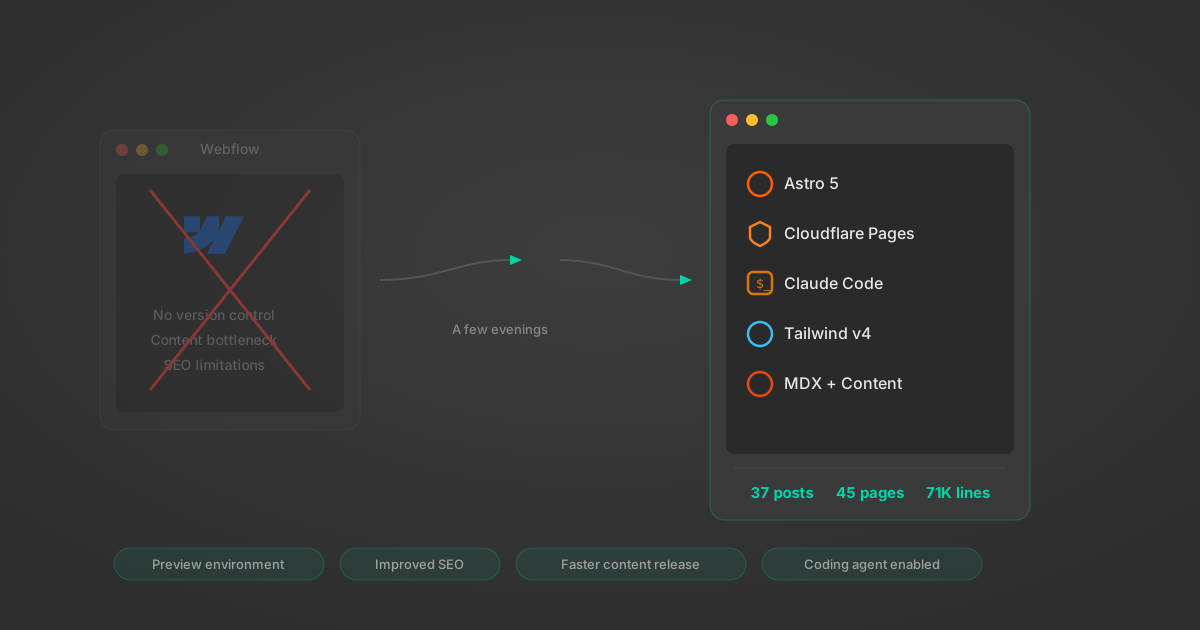
We replaced Webflow with Astro 5 + Cloudflare Pages in two weeks using Claude Code as the primary builder. 42 pages, 50 PRs — non-engineers ship independently.
15 min
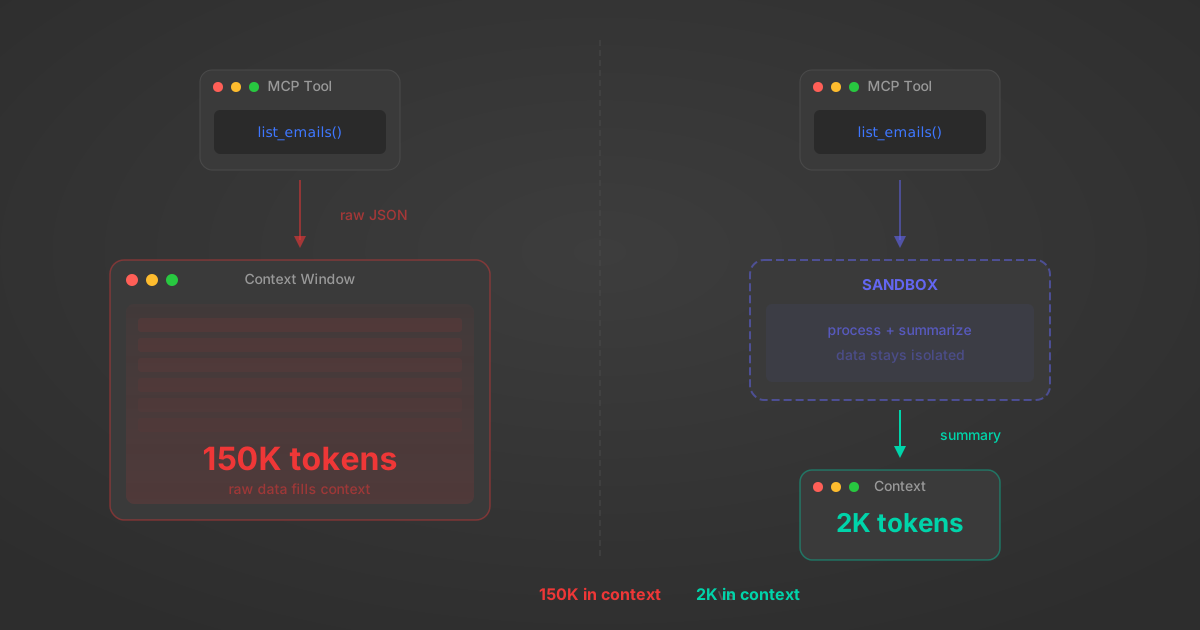
Anthropic's code_execution processes data already in context. Custom MCP code mode keeps raw tool responses in a sandbox. 14K tokens vs 500.
11 min
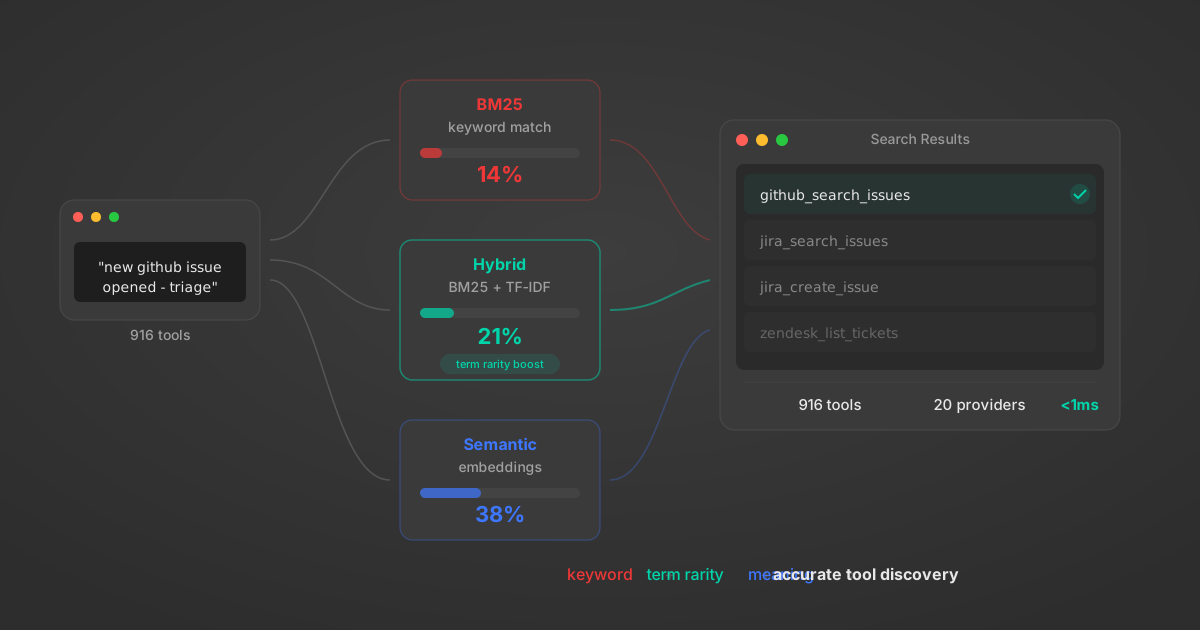
Benchmarking BM25, TF-IDF, and hybrid search for MCP tool discovery across 916 tools. The 80/20 TF-IDF/BM25 hybrid hits 21% Top-1 accuracy in under 1ms.
10 min
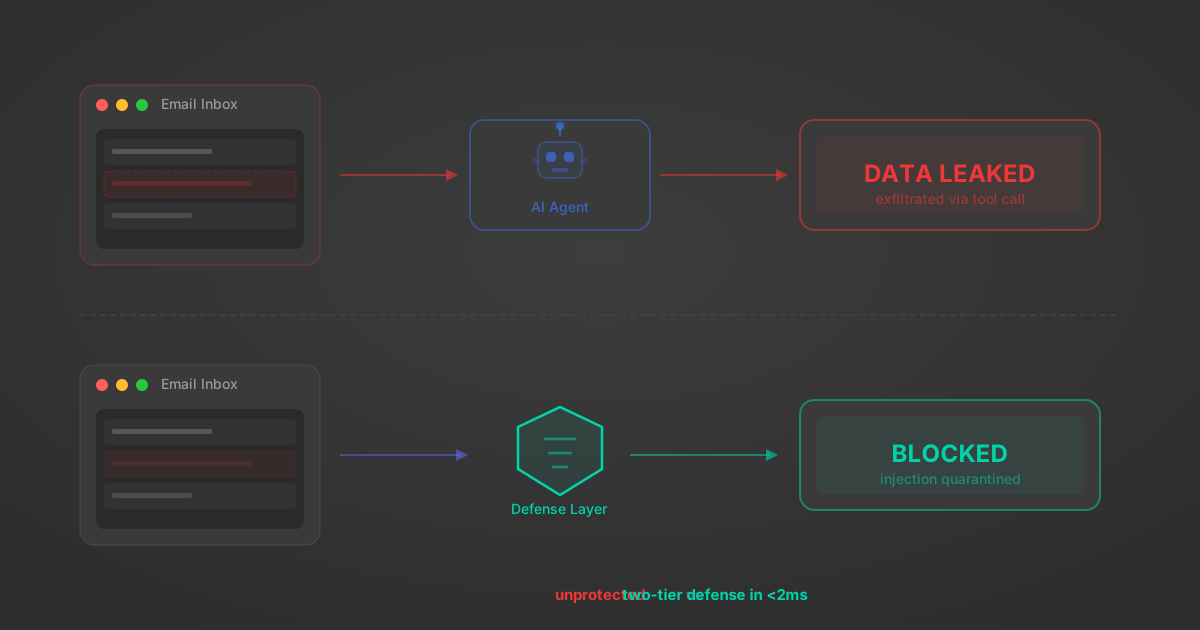
MCP tools that read emails, CRM records, and tickets are indirect prompt injection vectors. Here's how we built a two-tier defense that scans tool results in ~11ms.
12 min
origin_owner_id.All the tools you need to build and scale AI agent integrations, with best-in-class connectivity, execution, and security.