Connect
Optimize
Secure
Announcing StackOne Defender: leading open-source prompt injection guard for your agent • Read More →
Production-ready Gmail MCP server with 42 extensible actions — plus built-in authentication, security, and optimized execution.
 StackOne
Coverage
Create, read, update, and delete across Gmail — and extend your agent's capabilities with custom actions.

Authentication
Per-user OAuth in one call. Your Gmail MCP server gets session-scoped tokens with zero credentials stored on your infra.
Agent Auth →
Security
Every Gmail tool response scanned for prompt injection in milliseconds — 88.7% accuracy, all running on CPU.
Prompt Injection Defense →
Performance
Free up to 96% of your agent's context window to enhance reasoning and reduce cost, on every Gmail call.
Tools Discovery →A Gmail MCP server lets AI agents read and write Gmail data through the Model Context Protocol — Anthropic's open standard for connecting LLMs to external tools. StackOne's Gmail MCP server ships with 42 pre-built actions, fully extensible via the Connector Builder — plus managed authentication, prompt injection defense, and optimized agent context. Connect it from MCP clients like Claude Desktop, Cursor, and VS Code, or from agent frameworks like OpenAI Agents SDK, LangChain, and Vercel AI SDK.
Every action from Gmail's API, ready for your agent. Create, read, update, and delete — scoped to exactly what you need.
Create and save a new unsent email draft in Gmail using RFC 2822 formatted message content encoded as base64url, without sending it to recipients.
Immediately send a previously saved draft email to all its recipients, removing it from the Drafts folder and placing the sent message in the Sent folder.
Retrieve a paginated list of all draft emails saved in the authenticated user's Gmail account, returning draft IDs and basic message metadata for subsequent retrieval.
Retrieve the full content of a specific draft email by its draft ID, with configurable response format to control the verbosity and structure of the data returned.
Fully replace the content of an existing draft by providing a new RFC 2822 message payload, enabling changes to recipients, subject, body, attachments, or any other email fields.
Permanently and irrecoverably delete a draft email by its draft ID, removing it from the Drafts folder immediately with no trash step or recovery option.
Create a new Gmail filter rule that automatically processes future incoming messages matching specified criteria, applying labels, archiving, forwarding, or removing other labels.
Retrieve all email filter rules configured in the Gmail account that automatically process incoming messages based on criteria like sender, subject, size, or custom search queries.
Retrieve the complete configuration of a specific Gmail filter rule by its ID, including the full matching criteria definition and the action applied to messages that match.
Permanently remove a Gmail filter rule by its ID, immediately stopping all future automatic processing of incoming messages that previously matched the filter's criteria.
Create a new custom Gmail label for organizing email messages, with options to set its display name, sidebar visibility, message list visibility, and a color theme.
Retrieve the complete list of Gmail labels in the authenticated user's mailbox, including both built-in system labels and user-created custom labels with their IDs required for filtering and modifying messages.
Retrieve the complete metadata for a specific Gmail label by its ID, including message and thread counts, sidebar visibility settings, and color configuration if set.
Partially update an existing Gmail label's name, visibility settings, or color using a PATCH request that only modifies the fields explicitly provided, leaving all other properties unchanged.
Permanently remove a custom Gmail label by its ID - all messages that had this label are preserved with the label stripped from them, and the label itself cannot be recovered.
Immediately send a new email message via Gmail by providing the complete RFC 2822 formatted message content encoded as a base64url string, delivering it directly to recipients without a draft step.
Retrieve a paginated list of email messages from the authenticated user's Gmail mailbox, returning message IDs and thread IDs that can be passed to get_message for full content retrieval.
Retrieve the complete content and metadata of a specific Gmail message by its ID, including all headers, body parts, and attachment references with MIME structure.
Permanently and irreversibly delete a Gmail message by its ID, bypassing the Trash folder entirely - use trash_message instead if there is any chance recovery may be needed.
Retrieve the current IMAP protocol settings for the Gmail account, including whether IMAP access is enabled for third-party email clients and how message deletion is handled by those clients.
Update the Gmail IMAP protocol settings to enable or disable IMAP access for third-party email clients, and configure how those clients handle message deletion and folder size limits.
Retrieve the current POP3 protocol settings for the Gmail account, showing which messages are accessible via POP3 and what happens to them in Gmail after a POP3 client downloads them.
Update the Gmail POP3 protocol settings to control which messages are downloadable by POP3 clients and what disposition action is applied to those messages in Gmail after a POP3 client retrieves them.
Retrieve the current vacation responder (out-of-office auto-reply) configuration, including whether it is active, the message content, the scheduled activation window, and recipient restriction policies.
Enable, disable, or update the Gmail vacation responder (out-of-office auto-reply) with custom message content, an optional scheduled activation window, and restrictions to limit which senders receive the auto-reply.
Search and list email conversation threads from Gmail using full Gmail search syntax, with support for filtering by sender, label, date, attachment presence, and other criteria.
Retrieve the complete email conversation thread including all messages in chronological order, with full MIME content, headers, body parts, and attachment references for each message.
Permanently and irreversibly delete an entire email thread and all its messages by thread ID, bypassing Trash - use trash_thread if there is any chance recovery might be needed.
Download the base64url-encoded binary content of a specific email attachment by providing the parent message ID and the attachment ID found in the message payload parts.
Retrieve a chronological log of all mailbox changes since a specific historyId checkpoint, enabling efficient incremental mailbox sync without re-fetching the entire inbox.
Retrieve all email forwarding addresses registered in the Gmail account settings, along with their verification status showing whether each address is authorized to receive forwarded emails.
Retrieve the details and verification status of a specific email forwarding address registered in Gmail settings, confirming whether it is authorized to receive automatically forwarded emails.
Retrieve the current auto-forwarding configuration showing whether all incoming emails are being automatically forwarded to another address and what disposition action is applied to original messages after forwarding.
Retrieve all send-as aliases configured for the Gmail account, including the primary address and any additional addresses the user is authorized to send from, along with their signatures and verification status.
Retrieve the complete configuration of a specific send-as alias by its email address, including the sender display name, HTML email signature, reply-to address, and verification status.
Retrieve the authenticated user's Gmail profile including their primary email address, total mailbox message and thread counts, and the current historyId required to bootstrap an incremental mailbox sync via list_history.
Add or remove Gmail labels on a specific message in a single call to star it, mark it as read or unread, move it to inbox, archive it, or apply and remove custom organization labels.
Move a Gmail message to the Trash folder so it can be recovered within 30 days - a safe, reversible alternative to the permanent delete_message operation.
Restore a previously trashed Gmail message back to the inbox by removing the TRASH label and restoring INBOX, reversing a trash_message operation within the 30-day recovery window.
Apply or remove Gmail labels on every message in an entire conversation thread simultaneously, enabling efficient bulk operations like marking a full conversation as read, starring it, or archiving it.
Move an entire email conversation thread and all its messages to the Gmail Trash folder, where it can be recovered within 30 days before automatic permanent deletion.
Restore a trashed email thread and all its messages back to the inbox by removing the TRASH label and restoring INBOX on all messages, reversing a trash_thread operation within the 30-day window.
One endpoint. Any framework. Your agent is talking to Gmail in under 10 lines of code.
MCP Clients
Agent Frameworks

 JSON
JSON{
"mcpServers": {
"stackone": {
"command": "npx",
"args": [
"-y",
"mcp-remote@latest",
"https://api.stackone.com/mcp?x-account-id=<account_id>",
"--header",
"Authorization: Basic <YOUR_BASE64_TOKEN>"
]
}
}
}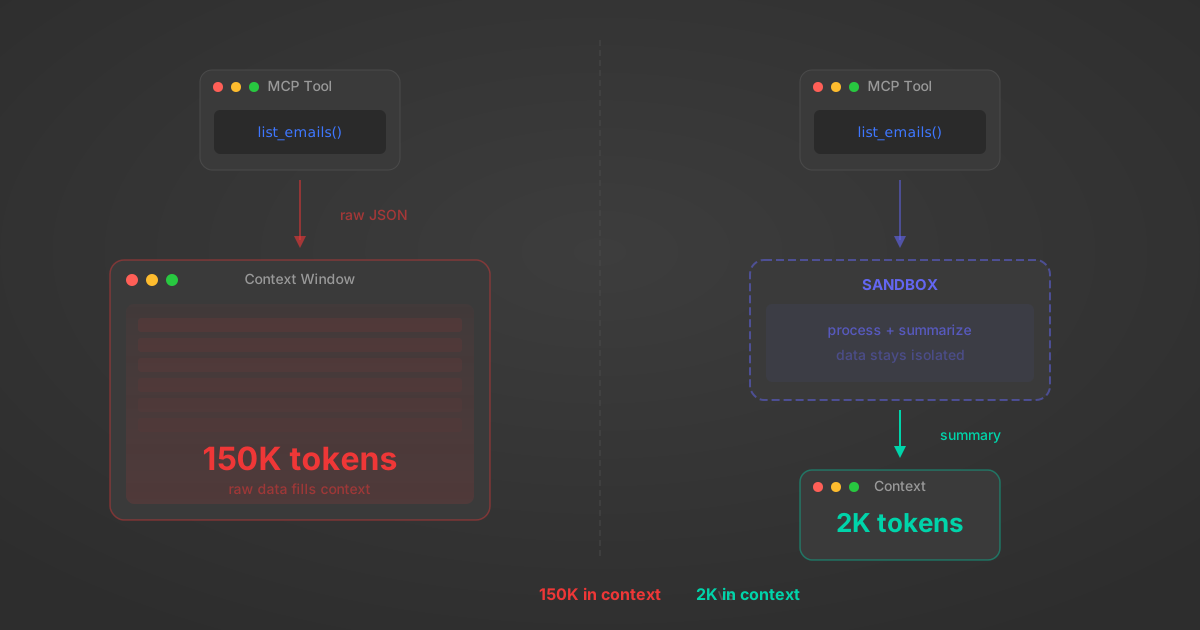
Anthropic's code_execution processes data already in context. Custom MCP code mode keeps raw tool responses in a sandbox. 14K tokens vs 500.
11 min
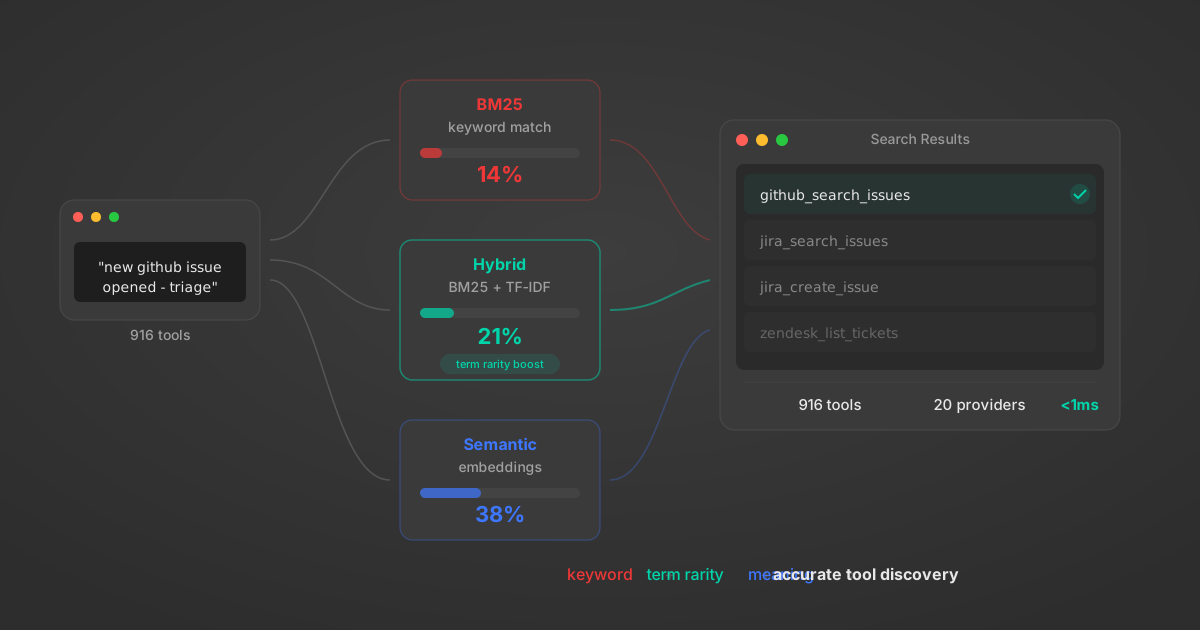
Benchmarking BM25, TF-IDF, and hybrid search for MCP tool discovery across 916 tools. The 80/20 TF-IDF/BM25 hybrid hits 21% Top-1 accuracy in under 1ms.
10 min
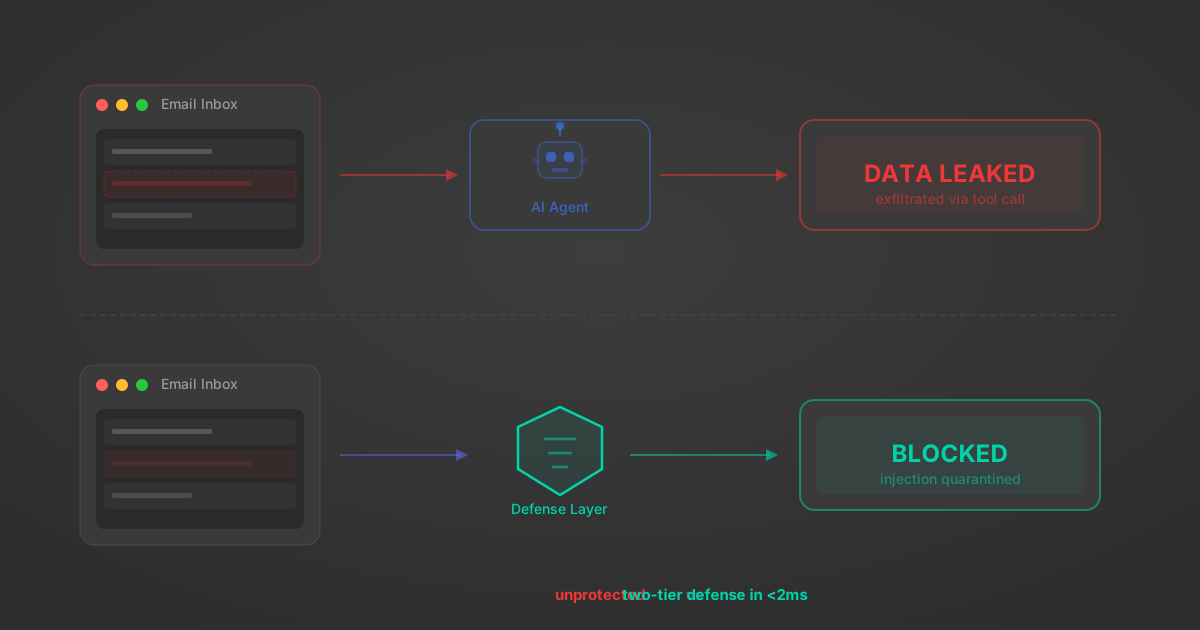
MCP tools that read emails, CRM records, and tickets are indirect prompt injection vectors. Here's how we built a two-tier defense that scans tool results in ~11ms.
12 min
origin_owner_id.All the tools you need to build and scale AI agent integrations, with best-in-class connectivity, execution, and security.