Connect
Optimize
Secure
Announcing StackOne Defender: leading open-source prompt injection guard for your agent • Read More →
Production-ready PeopleFluent MCP server with 54 extensible actions — plus built-in authentication, security, and optimized execution.
 StackOne
Coverage
Create, read, update, and delete across PeopleFluent — and extend your agent's capabilities with custom actions.

Authentication
Per-user OAuth in one call. Your PeopleFluent MCP server gets session-scoped tokens with zero credentials stored on your infra.
Agent Auth →
Security
Every PeopleFluent tool response scanned for prompt injection in milliseconds — 88.7% accuracy, all running on CPU.
Prompt Injection Defense →
Performance
Free up to 96% of your agent's context window to enhance reasoning and reduce cost, on every PeopleFluent call.
Tools Discovery →A PeopleFluent MCP server lets AI agents read and write PeopleFluent data through the Model Context Protocol — Anthropic's open standard for connecting LLMs to external tools. StackOne's PeopleFluent MCP server ships with 54 pre-built actions, fully extensible via the Connector Builder — plus managed authentication, prompt injection defense, and optimized agent context. Connect it from MCP clients like Claude Desktop, Cursor, and VS Code, or from agent frameworks like OpenAI Agents SDK, LangChain, and Vercel AI SDK.
Every action from PeopleFluent's API, ready for your agent. Create, read, update, and delete — scoped to exactly what you need.
Search and list learning modules from PeopleFluent LMS with optional keyword, date, and sort filtering.
Retrieve detailed information about a specific learning module or program by its ID from PeopleFluent LMS.
List all approved and logged external training records for the current user or a specified user in PeopleFluent LMS.
Retrieve full details for a single external training record by its unique ID from PeopleFluent LMS.
Retrieve all training records for the current user or a specified user from PeopleFluent LMS.
Retrieve a specific training record by its ID from PeopleFluent LMS including completion data, scores, and timestamps.
Retrieve the full content of a specific LMS message by its ID from PeopleFluent.
Update the status of an LMS message in PeopleFluent, typically to mark it as read or archived.
Create a new named user group in PeopleFluent LMS for organizing learners for bulk enrollments, reporting, and access control.
Permanently delete a named user group from PeopleFluent LMS without deleting the group's member users.
Assign a user group to be supervised by a specific user in PeopleFluent LMS, granting management and reporting access over that group.
Revoke a user's supervisor access over a specific user group in PeopleFluent LMS.
Add a user to an existing user group in PeopleFluent LMS to include them in group-level enrollments and reporting.
List users from PeopleFluent LMS with optional filtering by user ID, organization, or email address.
Retrieve the profile and session context for the currently authenticated user in PeopleFluent LMS.
List the direct reports for the current user or a specified manager in PeopleFluent LMS to retrieve their team members.
Search for people in PeopleFluent LMS using keywords, user ID, first name, or last name with optional result count limiting.
List all assignments for the current user or a specified user in PeopleFluent LMS to discover available role and position contexts.
Retrieve recent learning activity for the current user or a specified user in PeopleFluent LMS.
List all available learning paths from PeopleFluent LMS that the current user has access to.
Retrieve information about a specific catalog in PeopleFluent LMS including its parent, child catalogs, and contained modules.
List competency definitions from PeopleFluent LMS with optional keyword filtering and result limiting.
Retrieve full details for a single competency by its ID from PeopleFluent LMS.
List job profiles from PeopleFluent LMS with grouping and keyword filtering to discover role-based competency and training requirements.
List all job profiles currently assigned to the authenticated user or a specified user in PeopleFluent LMS.
List all competencies that have been awarded to the current user or a specified user in PeopleFluent LMS, including proficiency levels achieved.
Retrieve detailed information for a specific organization by its ID from PeopleFluent LMS.
List knowledge base articles from PeopleFluent LMS with optional filtering by keywords, publication dates, and category.
List all external training requests submitted by a user or visible to the current administrator in PeopleFluent LMS.
List pending and historical enrollment requests awaiting manager or administrator approval in PeopleFluent LMS.
List task approval items filtered by status for the current user's approval queue in PeopleFluent LMS.
List pending and historical withdrawal requests from learners seeking to unenroll from courses or programs in PeopleFluent LMS.
List pending supervisor assessments that require completion by the authenticated user or a specified supervisor in PeopleFluent LMS.
Retrieve the summary results for a specific assessment attempt by its ID from PeopleFluent LMS.
List all participants enrolled in a specific instructor-led training session in PeopleFluent LMS.
Retrieve facility details for a specific training location by its ID from PeopleFluent LMS.
List training resources available in PeopleFluent LMS such as equipment, instructors, and materials, with optional keyword filtering.
Retrieve messages from the PeopleFluent LMS mailbox for the current user or a specified user.
Retrieve the latest forum posts from PeopleFluent LMS as an RSS or Atom feed for integration with external feed readers or aggregators.
List available pre-generated batch reports from PeopleFluent LMS with optional filtering by name and creation date range.
Retrieve current API session information from PeopleFluent LMS to verify authentication status and session context.
Retrieve the current API version and build information from PeopleFluent LMS for compatibility verification.
Permanently delete an external training record from PeopleFluent LMS by its unique ID.
Remove a user from a user group in PeopleFluent LMS so they are excluded from future group-level operations.
Enroll a specific user in a course or learning program in PeopleFluent LMS by providing a learning ID and the target user ID.
Assign a job profile to a user in PeopleFluent LMS, automatically triggering the associated competency and training requirements for that role.
Remove a job profile assignment from a user in PeopleFluent LMS, disassociating the role's competency and training requirements.
Approve a pending enrollment request so the learner is confirmed into the requested course or program in PeopleFluent LMS.
Deny a pending enrollment request to prevent a learner from being enrolled in the requested course or program in PeopleFluent LMS.
Approve a pending withdrawal request to confirm a learner's unenrollment from a course or program in PeopleFluent LMS.
Deny a pending withdrawal request to keep the learner enrolled in their course or program in PeopleFluent LMS.
Record a content launch event for a learner enrollment in PeopleFluent LMS to initiate SCORM or AICC tracking.
Programmatically update the overall completion status of an enrollment record in PeopleFluent LMS.
Submit a completed assessment attempt with answers and scoring data to PeopleFluent LMS to record a learner's quiz or test result.
One endpoint. Any framework. Your agent is talking to PeopleFluent in under 10 lines of code.
MCP Clients
Agent Frameworks

 JSON
JSON{
"mcpServers": {
"stackone": {
"command": "npx",
"args": [
"-y",
"mcp-remote@latest",
"https://api.stackone.com/mcp?x-account-id=<account_id>",
"--header",
"Authorization: Basic <YOUR_BASE64_TOKEN>"
]
}
}
}122+ actions
79+ actions
78+ actions
72+ actions
69+ actions
69+ actions
67+ actions
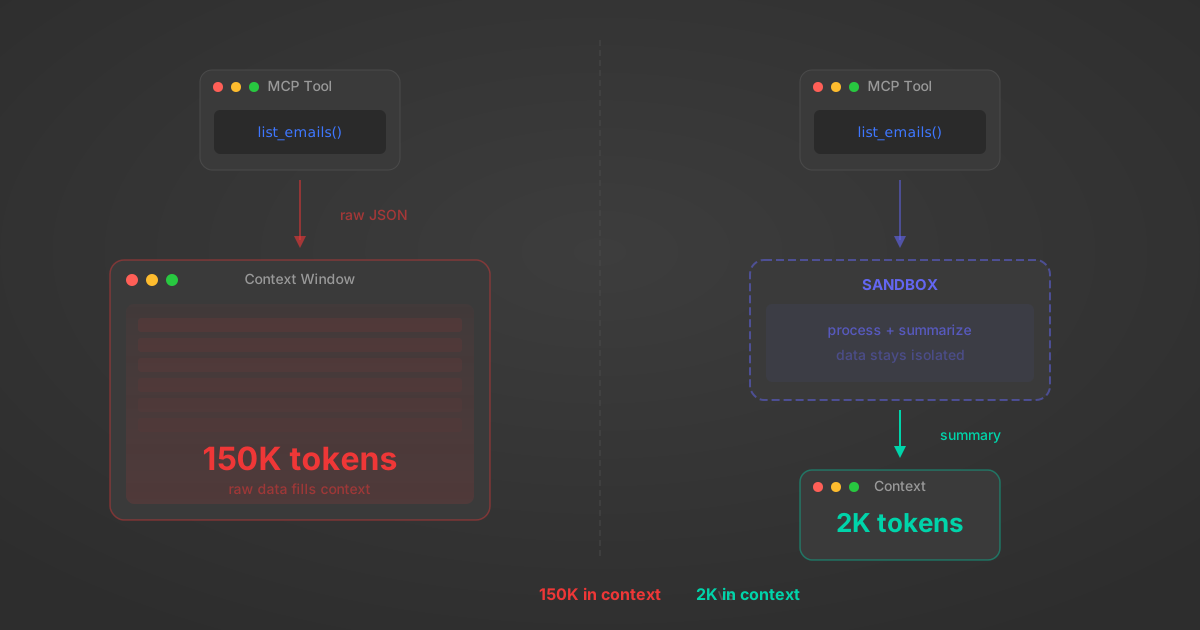
Anthropic's code_execution processes data already in context. Custom MCP code mode keeps raw tool responses in a sandbox. 14K tokens vs 500.
11 min
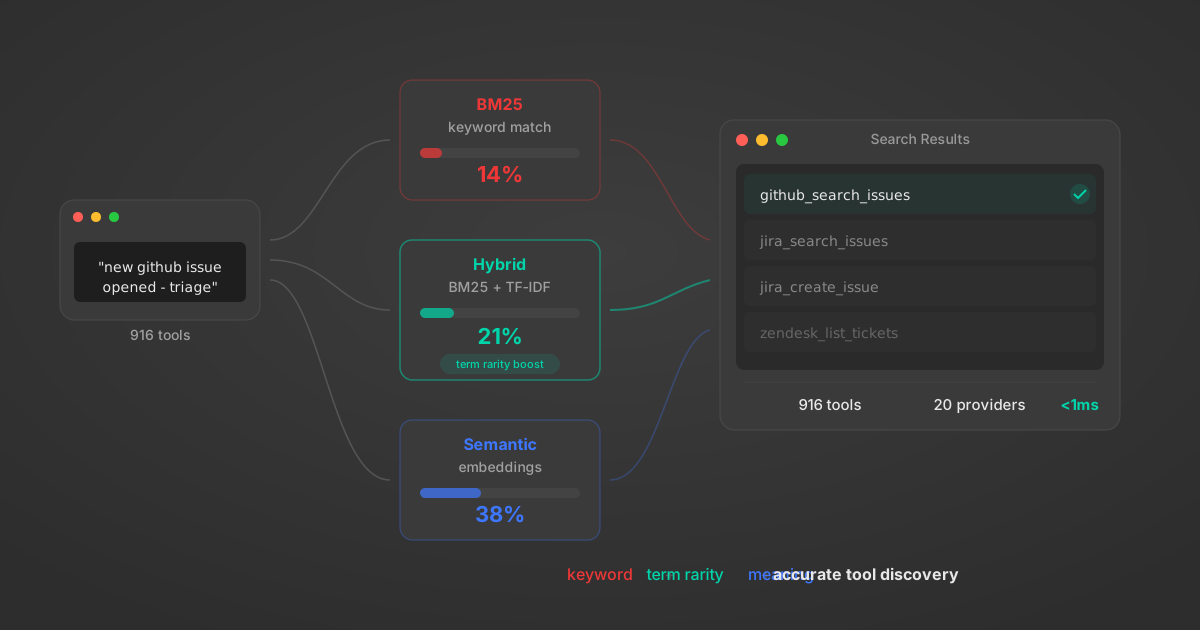
Benchmarking BM25, TF-IDF, and hybrid search for MCP tool discovery across 916 tools. The 80/20 TF-IDF/BM25 hybrid hits 21% Top-1 accuracy in under 1ms.
10 min
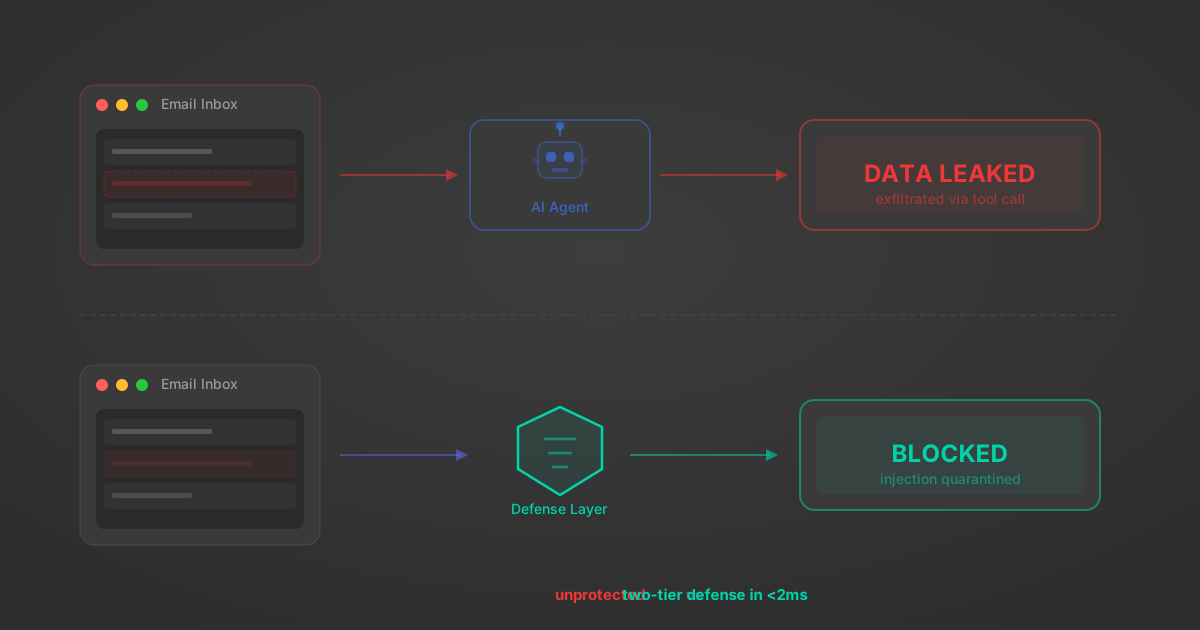
MCP tools that read emails, CRM records, and tickets are indirect prompt injection vectors. Here's how we built a two-tier defense that scans tool results in ~11ms.
12 min
origin_owner_id.All the tools you need to build and scale AI agent integrations, with best-in-class connectivity, execution, and security.