Connect
Optimize
Secure
Announcing StackOne Defender: leading open-source prompt injection guard for your agent • Read More →
Use StackOne to connect your AI agent to your accounting, messaging, and ticketing systems to automate intercompany reconciliation.




AI Agents
MCP and A2A to REST, SOAP, and proprietary APIs.
Tool discovery, data shaping, and reliable execution.
Scoped permissions, audit trails, and observability.
StackOne Integration Layer


 StackOne Integration Layer
200+ connectors, build your own, and multi-protocol support.
Context, token, and speed optimization infrastructure.
Permissions API and prompt injection protection.
Your agent pulls transactions from every entity, normalizes currencies, matches payables against receivables, routes discrepancies, and generates elimination entries.
Pull intercompany transactions from each entity's accounting system for the reconciliation period, filtering by intercompany account codes from QuickBooks, Xero, or Zoho Books.
Standardize currencies using period-end exchange rates, align chart-of-account mappings, and harmonize date formats across entities so the agent can compare entries directly.
Match intercompany payables against corresponding receivables using invoice number, amount tolerance, and entity pair. Flag partial matches and timing differences for review.
Generate intercompany elimination journal entries for matched and resolved items, mapped to consolidation accounts per GAAP and IFRS rules.
Generate a summary report showing matched totals, outstanding discrepancies, elimination entries, and aging of unresolved items. Store and share via Google Drive or SharePoint.
Pull intercompany transactions from each entity's accounting system for the reconciliation period, filtering by intercompany account codes from QuickBooks, Xero, or Zoho Books.
Standardize currencies using period-end exchange rates, align chart-of-account mappings, and harmonize date formats across entities so the agent can compare entries directly.
Match intercompany payables against corresponding receivables using invoice number, amount tolerance, and entity pair. Flag partial matches and timing differences for review.
Generate intercompany elimination journal entries for matched and resolved items, mapped to consolidation accounts per GAAP and IFRS rules.
Generate a summary report showing matched totals, outstanding discrepancies, elimination entries, and aging of unresolved items. Store and share via Google Drive or SharePoint.
An intercompany reconciliation agent needs connectors to QuickBooks, Xero, Zoho Books, and Dynamics 365 for transactions, plus Slack, Jira, and Google Drive for routing and reporting. Building and maintaining each one — OAuth, pagination, rate limits — is a massive lift that grows with every entity you add.
Every accounting system uses different auth — OAuth 2.0 for Xero, custom OAuth for QuickBooks, API keys for others. Managing credentials across dozens of entity connections drains engineering time from reconciliation logic.
Without search-first architecture, the agent pre-loads every action definition across all accounting, messaging, and ticketing connectors — burning tokens and money before matching a single transaction. The problem compounds with multi-entity reconciliation at high volume.
Intercompany transactions contain free-text fields — invoice descriptions, journal memos, vendor names — that an attacker could craft to hijack agent behavior. Every entity connection multiplies the injection surface.
Everything your reconciliation agent needs to pull transactions across entities, match entries, route discrepancies, and generate elimination entries — with the controls finance teams demand.
Pre-built connectors for QuickBooks, Xero, Zoho Books, Dynamics 365, Stripe, Slack, Jira, and more — each with agent-ready action definitions and instructions included.
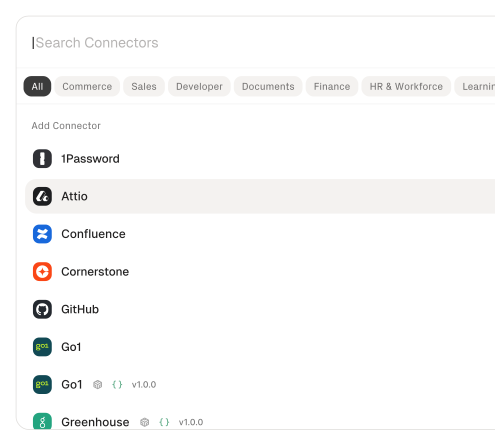
OAuth flows, API key rotation, and token refresh managed per tenant for every connected accounting and messaging system — one setup per provider, not per entity.
Agent searches StackOne's action catalog by natural language and executes the matching accounting, messaging, or ticketing action — no pre-loading thousands of tool definitions across providers.
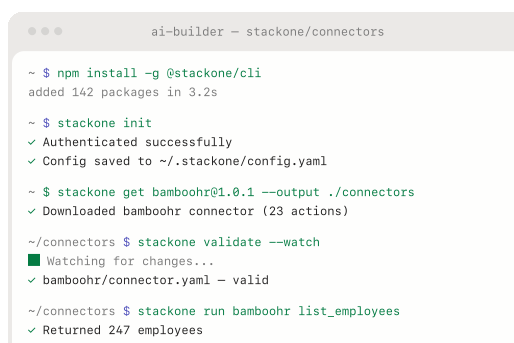
If an entity runs a niche accounting system without a pre-built connector, AI Connector Builder lets you build a production-grade REST or SOAP connector without starting from scratch.
Every reconciliation workflow processes external financial data. Defender screens invoice descriptions, journal memos, and vendor names for injection attempts before they reach the agent's context window.
Every API call — transaction reads, discrepancy notifications, report uploads — is logged with endpoint, timestamp, and status. Export to Grafana or Datadog for a complete audit trail.
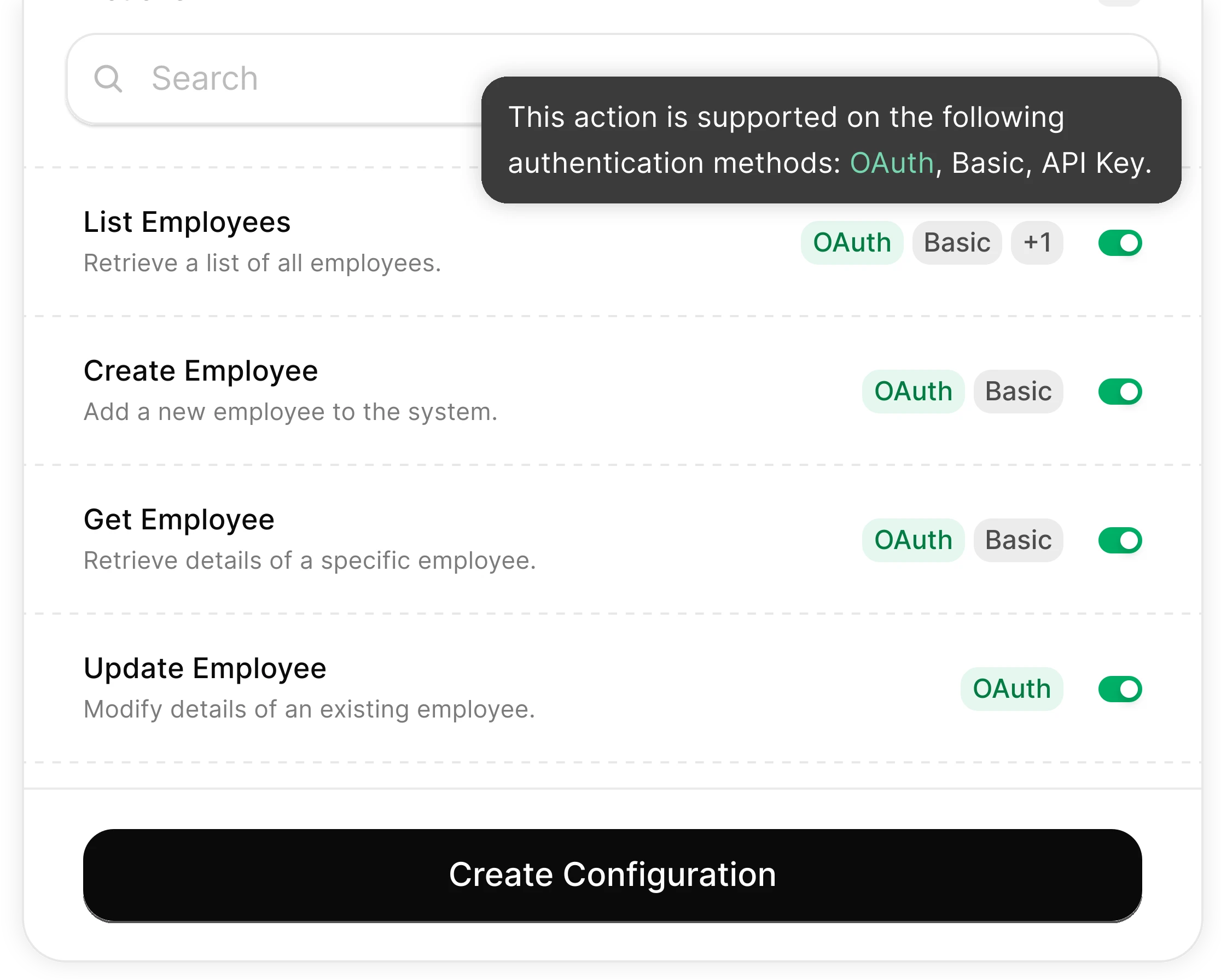
Scoped permissions define exactly which accounts and actions the agent can access. Full audit trail of every reconciliation read and write for SOX and GAAP compliance.

Claude, OpenAI, LangChain, Vercel AI SDK, CrewAI, Pydantic AI — StackOne works with every major agent framework out of the box.


Whether you're building with code, a visual builder, or an enterprise platform — StackOne provides the integration layer your agent needs.
Start building in minutes. MCP connectors to every system your agent needs.
Automate invoice processing with AI agents connected to your ERP, accounting software, and AP tools through StackOne.
View →Use StackOne to connect your AI agent to your accounting, CRM, and messaging systems to automate AR dunning and payment follow-up.
View →Use StackOne to connect your AI agent to your bank feeds, ERP, and accounting systems to automate bank reconciliation.
View →Use StackOne to connect your AI agent to your accounting, email, and document management systems to automate invoice processing and purchase order matching.
View →Use StackOne to connect your AI agent to your payment, compliance, and ticketing systems to automate transaction monitoring and SAR filing.
View →Start building in minutes. MCP connectors to every system your agent needs.