Connect
Optimize
Secure
Announcing StackOne Defender: leading open-source prompt injection guard for your agent • Read More →
Production-ready Amplitude MCP server with 53 extensible actions — plus built-in authentication, security, and optimized execution.
 StackOne
Coverage
Create, read, update, and delete across Amplitude — and extend your agent's capabilities with custom actions.

Authentication
Per-user OAuth in one call. Your Amplitude MCP server gets session-scoped tokens with zero credentials stored on your infra.
Agent Auth →
Security
Every Amplitude tool response scanned for prompt injection in milliseconds — 88.7% accuracy, all running on CPU.
Prompt Injection Defense →
Performance
Free up to 96% of your agent's context window to enhance reasoning and reduce cost, on every Amplitude call.
Tools Discovery →A Amplitude MCP server lets AI agents read and write Amplitude data through the Model Context Protocol — Anthropic's open standard for connecting LLMs to external tools. StackOne's Amplitude MCP server ships with 53 pre-built actions, fully extensible via the Connector Builder — plus managed authentication, prompt injection defense, and optimized agent context. Connect it from MCP clients like Claude Desktop, Cursor, and VS Code, or from agent frameworks like OpenAI Agents SDK, LangChain, and Vercel AI SDK.
Every action from Amplitude's API, ready for your agent. Create, read, update, and delete — scoped to exactly what you need.
Send one or more events to Amplitude using the HTTP V2 API for real-time event tracking and user behavior analysis.
Retrieve all event types in the project with current week totals and metrics.
Export event data from Amplitude for a specified date range. Returns a gzip-compressed archive of JSON files.
Upload multiple events to Amplitude in a single request for efficient bulk event processing.
Create a new cohort or update an existing one by uploading a set of user IDs or Amplitude IDs.
Retrieve a list of all cohorts in your Amplitude project for audience segmentation and behavioral analysis.
Retrieve detailed information about a specific cohort including its definition, size, and metadata.
Download the list of users in a specific cohort after the async request has completed. Returns user IDs and associated data for audience analysis.
Create a new event category for organizing event types in your Amplitude project.
Retrieve a specific event category by name.
Rename an existing event category.
Remove an event category from your Amplitude project.
Create a new event type in your Amplitude project's taxonomy for tracking and categorization.
Retrieve all event types in your Amplitude project with their metadata, categories, and configuration.
Retrieve details of a specific event type including its properties, category, and configuration.
Update an existing event type's metadata, category, visibility, or other configuration.
Delete an event type from your Amplitude project's taxonomy.
Create a new event property in your Amplitude taxonomy for a specific event type.
Retrieve details of a specific event property.
Update an existing event property's metadata, type, or configuration.
Delete an event property from your Amplitude taxonomy.
Retrieve all user properties defined in your Amplitude project's taxonomy.
Update user properties or associate a device ID with a user ID without sending an event, using the Identify API.
Create a new user property in your Amplitude project's taxonomy for user data governance.
Retrieve details of a specific user property from your Amplitude taxonomy.
Update an existing user property's metadata, type, or configuration.
Delete a user property from your Amplitude project's taxonomy.
Create a new group property in your Amplitude taxonomy for a specific group type.
Retrieve details of a specific group property from your Amplitude taxonomy.
Update an existing group property's metadata, type, or configuration.
Retrieve data from Amplitude dashboard charts in JSON format for custom reporting and analysis.
Retrieve counts of active or new users over a specified date range with optional segmentation.
Retrieve active user counts with 5-minute granularity for the past 2 days.
Retrieve funnel conversion and drop-off rates for a sequence of up to 4 events.
Retrieve user retention metrics for starting and returning actions over a date range.
Retrieve lifetime value metrics for new users including ARPU, ARPPU, total revenue, and paying user counts.
Retrieve average session length in seconds for each day in a specified date range.
Retrieve session count distribution across time buckets for a specified date range.
Retrieve the average number of sessions per user for each day in a specified date range.
Retrieve the distribution of users across values of a user property in a specified date range.
Check the status of an asynchronous cohort download request to determine if the cohort data is ready for download.
Retrieve all event categories in your Amplitude project for organizing event types.
Retrieve all properties for a specific event type in your Amplitude taxonomy.
Retrieve all group properties for a specific group type in your Amplitude taxonomy.
Retrieve user profile data including properties, cohort memberships, recommendations, computations, and prediction propensities. This API isn't supported for customers in Amplitude's EU data processing region.
Search for a user by Amplitude ID, device ID, or user ID and retrieve their summary information.
Retrieve a user's summary and recent or earliest events by their Amplitude ID.
Add or remove users from an existing cohort by incrementally updating its membership.
Perform event segmentation analysis to understand how different user segments interact with specific events over time.
Set or update group properties without sending an event, using the Group Identify API for B2B and account-level analytics.
Restore a previously deleted event type in your Amplitude project's taxonomy.
Restore a previously deleted event property in your Amplitude taxonomy.
Restore a previously deleted user property in your Amplitude project's taxonomy.
One endpoint. Any framework. Your agent is talking to Amplitude in under 10 lines of code.
MCP Clients
Agent Frameworks

 JSON
JSON{
"mcpServers": {
"stackone": {
"command": "npx",
"args": [
"-y",
"mcp-remote@latest",
"https://api.stackone.com/mcp?x-account-id=<account_id>",
"--header",
"Authorization: Basic <YOUR_BASE64_TOKEN>"
]
}
}
}114+ actions
104+ actions
101+ actions
100+ actions
80+ actions
63+ actions
34+ actions
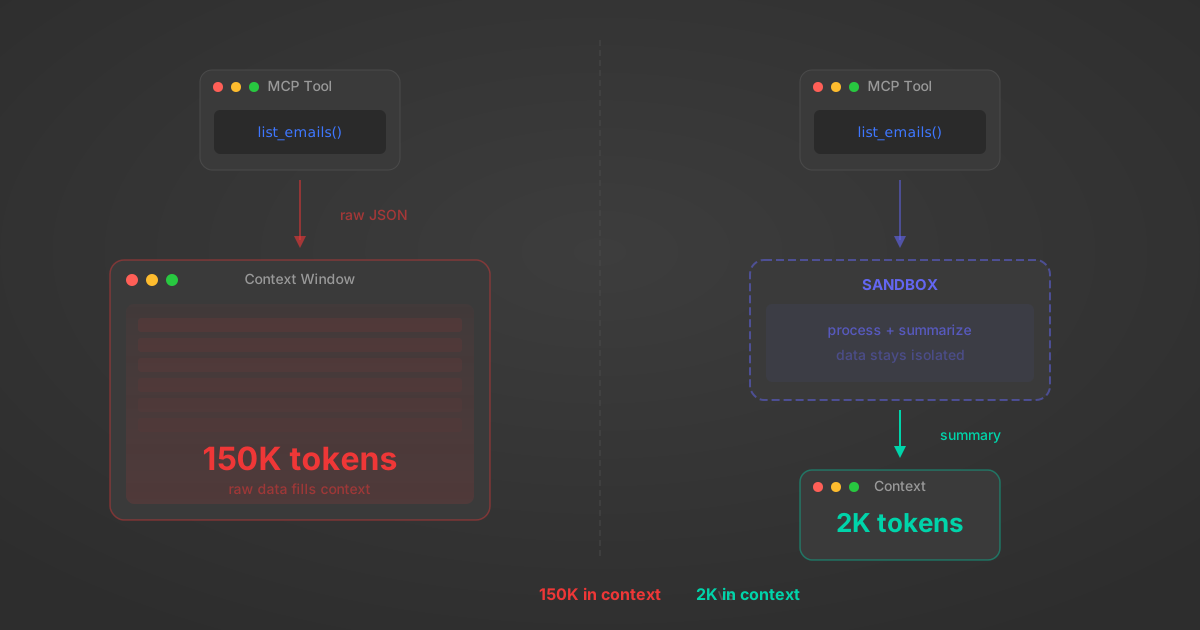
Anthropic's code_execution processes data already in context. Custom MCP code mode keeps raw tool responses in a sandbox. 14K tokens vs 500.
11 min
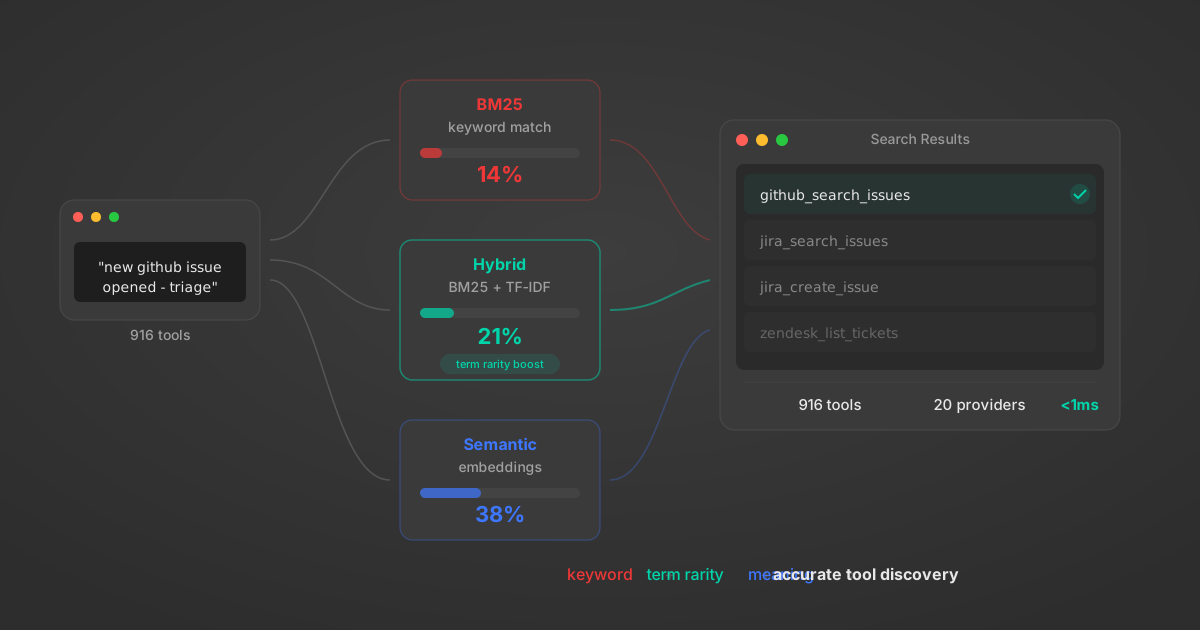
Benchmarking BM25, TF-IDF, and hybrid search for MCP tool discovery across 916 tools. The 80/20 TF-IDF/BM25 hybrid hits 21% Top-1 accuracy in under 1ms.
10 min
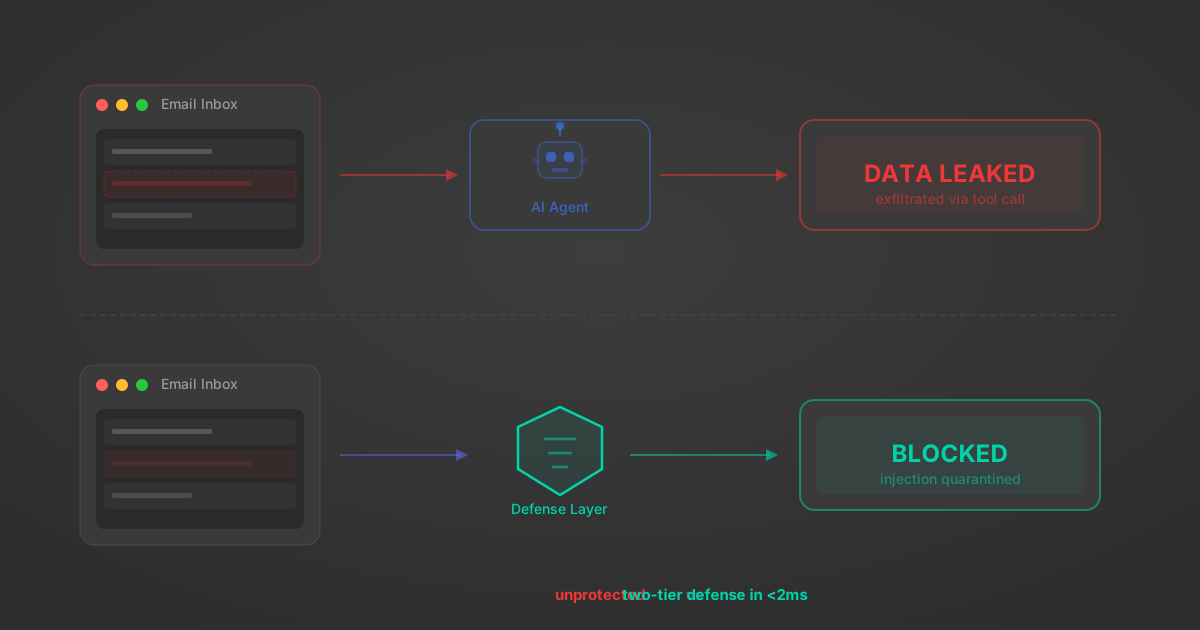
MCP tools that read emails, CRM records, and tickets are indirect prompt injection vectors. Here's how we built a two-tier defense that scans tool results in ~11ms.
12 min
origin_owner_id.All the tools you need to build and scale AI agent integrations, with best-in-class connectivity, execution, and security.