Connect
Optimize
Secure
Announcing StackOne Defender: leading open-source prompt injection guard for your agent • Read More →
Production-ready Datadog MCP server with 26 extensible actions — plus built-in authentication, security, and optimized execution.
 StackOne
Coverage
Create, read, update, and delete across Datadog — and extend your agent's capabilities with custom actions.

Authentication
Per-user OAuth in one call. Your Datadog MCP server gets session-scoped tokens with zero credentials stored on your infra.
Agent Auth →
Security
Every Datadog tool response scanned for prompt injection in milliseconds — 88.7% accuracy, all running on CPU.
Prompt Injection Defense →
Performance
Free up to 96% of your agent's context window to enhance reasoning and reduce cost, on every Datadog call.
Tools Discovery →A Datadog MCP server lets AI agents read and write Datadog data through the Model Context Protocol — Anthropic's open standard for connecting LLMs to external tools. StackOne's Datadog MCP server ships with 26 pre-built actions, fully extensible via the Connector Builder — plus managed authentication, prompt injection defense, and optimized agent context. Connect it from MCP clients like Claude Desktop, Cursor, and VS Code, or from agent frameworks like OpenAI Agents SDK, LangChain, and Vercel AI SDK.
Every action from Datadog's API, ready for your agent. Create, read, update, and delete — scoped to exactly what you need.
Search and filter Datadog logs using log search syntax.
List recent log events from Datadog with optional filtering.
Create a new monitor to alert on metrics, logs, or other data sources.
Get all monitors with optional filtering by name, tags, or state.
Get details about a specific monitor by its ID.
Edit an existing monitor's configuration, thresholds, or notification settings.
CREATE a new service definition or UPDATE an existing service definition in the Datadog Service Catalog. Use for creating, adding, or registering services.
List all service definitions in the service catalog with ownership and metadata.
Retrieve the service definition for a specific service by name.
Delete a service definition from the service catalog.
Search and filter APM spans/traces for debugging performance issues with latency and error analysis.
Get a list of spans matching a search query with optional time range filtering.
Create a new log index in Datadog.
Get all log indexes in the organization.
Get the list of actively reporting metrics from a given time until now.
Query timeseries points to get actual metric data values over time.
Get metadata about a specific metric.
Get the tag configuration for a specific metric.
View indexed and ingested tags for a given metric name.
Get all APM service dependencies showing upstream and downstream service relationships.
Get the list of APM retention filters for your organization.
Compute aggregations and statistics over log data for pattern analysis and error counting.
Submit custom metric data points to Datadog for graphing on dashboards.
Query timeseries data across multiple products (metrics, logs, spans, etc.) with formulas and functions.
Get a single aggregated scalar value (not timeseries) from Datadog metrics. Returns one number like average CPU, total count, or max memory for dashboard widgets, alerts, and summary statistics.
Aggregate spans into buckets and compute metrics and timeseries for latency analysis.
One endpoint. Any framework. Your agent is talking to Datadog in under 10 lines of code.
MCP Clients
Agent Frameworks

 JSON
JSON{
"mcpServers": {
"stackone": {
"command": "npx",
"args": [
"-y",
"mcp-remote@latest",
"https://api.stackone.com/mcp?x-account-id=<account_id>",
"--header",
"Authorization: Basic <YOUR_BASE64_TOKEN>"
]
}
}
}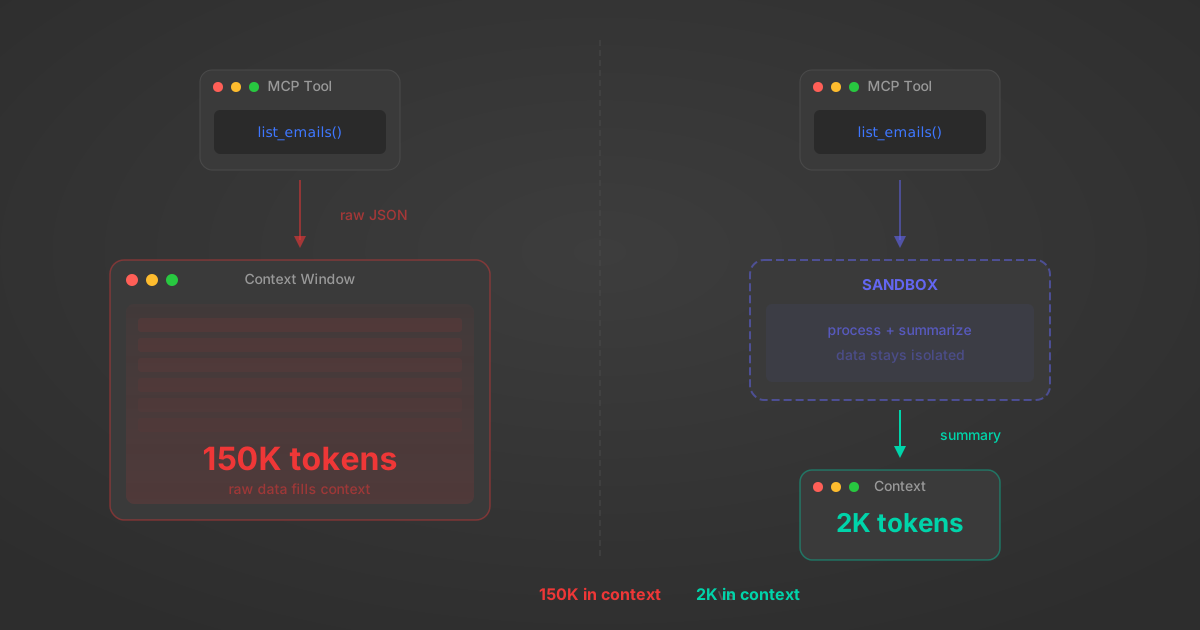
Anthropic's code_execution processes data already in context. Custom MCP code mode keeps raw tool responses in a sandbox. 14K tokens vs 500.
11 min
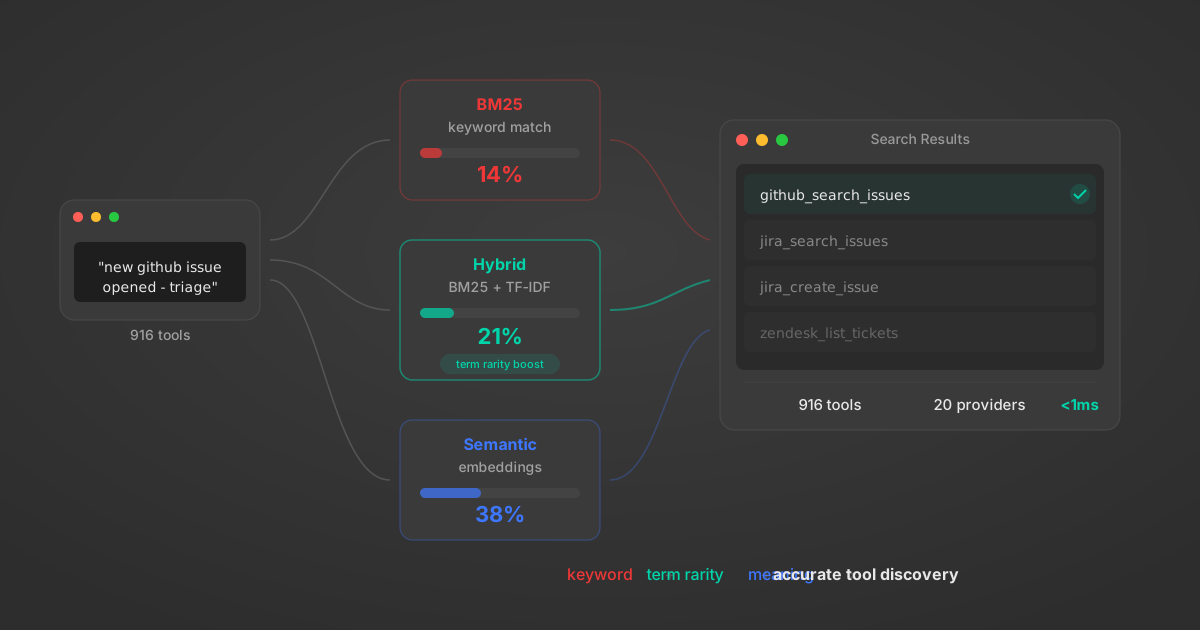
Benchmarking BM25, TF-IDF, and hybrid search for MCP tool discovery across 916 tools. The 80/20 TF-IDF/BM25 hybrid hits 21% Top-1 accuracy in under 1ms.
10 min
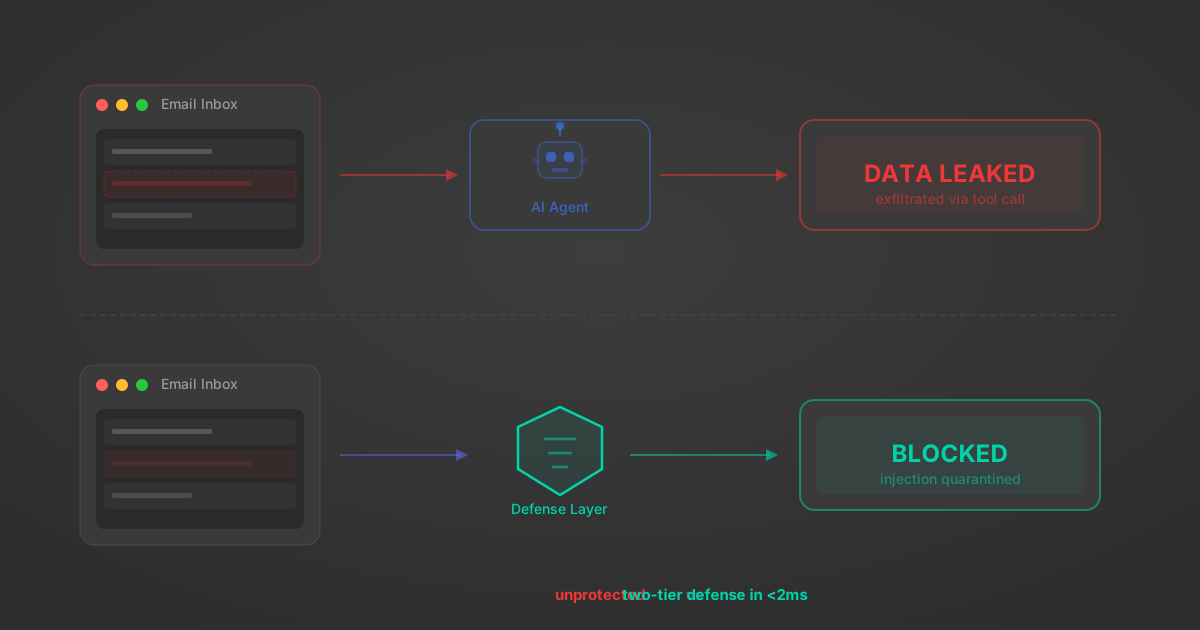
MCP tools that read emails, CRM records, and tickets are indirect prompt injection vectors. Here's how we built a two-tier defense that scans tool results in ~11ms.
12 min
origin_owner_id.All the tools you need to build and scale AI agent integrations, with best-in-class connectivity, execution, and security.