Connect
Optimize
Secure
Announcing StackOne Defender: leading open-source prompt injection guard for your agent • Read More →
Production-ready Render MCP server with 81 extensible actions — plus built-in authentication, security, and optimized execution.
 StackOne
Coverage
Create, read, update, and delete across Render — and extend your agent's capabilities with custom actions.

Authentication
Per-user OAuth in one call. Your Render MCP server gets session-scoped tokens with zero credentials stored on your infra.
Agent Auth →
Security
Every Render tool response scanned for prompt injection in milliseconds — 88.7% accuracy, all running on CPU.
Prompt Injection Defense →
Performance
Free up to 96% of your agent's context window to enhance reasoning and reduce cost, on every Render call.
Tools Discovery →A Render MCP server lets AI agents read and write Render data through the Model Context Protocol — Anthropic's open standard for connecting LLMs to external tools. StackOne's Render MCP server ships with 81 pre-built actions, fully extensible via the Connector Builder — plus managed authentication, prompt injection defense, and optimized agent context. Connect it from MCP clients like Claude Desktop, Cursor, and VS Code, or from agent frameworks like OpenAI Agents SDK, LangChain, and Vercel AI SDK.
Every action from Render's API, ready for your agent. Create, read, update, and delete — scoped to exactly what you need.
Create a new Render service (web service, static site, background worker, cron job, or private service).
Retrieve a paginated list of services in your Render workspace with filtering options.
Retrieve details for a specific Render service by its ID.
Update the configuration of an existing Render service.
Permanently delete a Render service and all its associated data.
Configure autoscaling for a Render service to automatically adjust instance count based on CPU or memory load.
Remove autoscaling configuration from a Render service, returning it to manual scaling.
Retrieve a paginated list of deploys for a specific Render service with filtering by status and date range.
Retrieve details for a specific deploy including status, commit information, and timestamps.
Retrieve all environment variables configured for a Render service.
Retrieve a specific environment variable from a Render service by its key.
Add or update a single environment variable for a Render service.
Remove a specific environment variable from a Render service.
Retrieve all secret files configured for a Render service.
Retrieve a specific secret file from a Render service by its filename.
Add or update a single secret file for a Render service.
Remove a specific secret file from a Render service.
Create and attach a new persistent disk to a Render service.
Retrieve a paginated list of persistent disks in your Render workspace.
Retrieve details for a specific persistent disk by its ID.
Update the configuration of an existing persistent disk, such as resizing it.
Permanently delete a persistent disk and all its data.
Add a custom domain to a Render service.
Retrieve all custom domains configured for a Render service.
Retrieve details for a specific custom domain including its verification status and DNS configuration.
Remove a custom domain from a Render service.
Add a single redirect or rewrite rule to a Render static site service.
Retrieve all redirect and rewrite rules configured for a Render static site service.
Remove a specific route rule from a Render static site service.
Add a single custom HTTP response header rule to a Render static site service.
Retrieve all custom HTTP header rules configured for a Render static site.
Remove a specific custom HTTP header rule from a Render static site.
Retrieve a paginated list of one-off jobs for a Render service.
Retrieve details and status for a specific one-off job.
Add a new Docker registry credential to your Render workspace for pulling private images.
Retrieve a paginated list of Docker registry credentials in your Render workspace.
Retrieve configuration details for a specific Docker registry credential by its ID.
Update the name, registry type, username, or authentication token of an existing Docker registry credential.
Permanently remove a Docker registry credential from your Render workspace.
Retrieve all members of a Render workspace/team.
Remove a member from a Render workspace/team.
Retrieve notification preferences for a Render workspace owner.
Update notification preferences for a Render workspace owner.
Retrieve the notification settings override for a specific Render service.
Update notification settings for a specific service, overriding workspace defaults.
Retrieve a list of Render Blueprints (infrastructure-as-code definitions) in your workspace.
Retrieve details for a specific Render Blueprint including its current sync status.
Update the configuration of an existing Render Blueprint.
Disconnect (delete) a Render Blueprint without deleting the services it manages.
Create a preview deployment of a Render service for testing changes in isolation.
Create and run a one-off job for a Render service to execute an ad-hoc command.
Retrieve the list of currently running instances for a Render service.
Retrieve a list of available snapshots for a persistent disk.
Retrieve the profile of the authenticated Render user.
Retrieve a list of all workspaces and teams the authenticated user belongs to.
Retrieve details for a specific Render owner/workspace by ID.
Retrieve audit logs for a Render workspace to track actions and changes.
Retrieve audit logs across all workspaces in a Render organization.
Retrieve all service-level notification setting overrides in your workspace.
Retrieve a log of events that have occurred for a Render service.
Retrieve details for a specific Render service event by its ID.
Retrieve a history of sync operations for a Render Blueprint.
Update the processing priority of a specific route rule for a Render static site.
Update the role of a member within a Render workspace/team.
Suspend a running Render service to stop it from serving traffic and reduce costs.
Resume a previously suspended Render service to restore traffic and restart instances.
Restart a running Render service without triggering a new build or deploy.
Manually set the number of running instances for a Render service.
Purge the CDN cache for a Render static site or web service to force fresh content delivery.
Trigger a new deployment for a Render service, optionally specifying a commit or clearing the build cache.
Cancel an in-progress deployment for a Render service.
Rollback a Render service to a previously deployed version.
Replace all environment variables for a Render service with a new set.
Replace all secret files for a Render service with a new set.
Restore a persistent disk to a previous state using a snapshot.
Trigger DNS verification for a custom domain to confirm correct configuration.
Replace all route rules for a Render static site service with a new set.
Replace all custom HTTP header rules for a Render static site with a new set.
Cancel a currently running one-off job.
Manually trigger an immediate run of a Render cron job outside its scheduled time.
Cancel a currently running cron job execution.
One endpoint. Any framework. Your agent is talking to Render in under 10 lines of code.
MCP Clients
Agent Frameworks

 JSON
JSON{
"mcpServers": {
"stackone": {
"command": "npx",
"args": [
"-y",
"mcp-remote@latest",
"https://api.stackone.com/mcp?x-account-id=<account_id>",
"--header",
"Authorization: Basic <YOUR_BASE64_TOKEN>"
]
}
}
}172+ actions
137+ actions
134+ actions
128+ actions
125+ actions
118+ actions
109+ actions
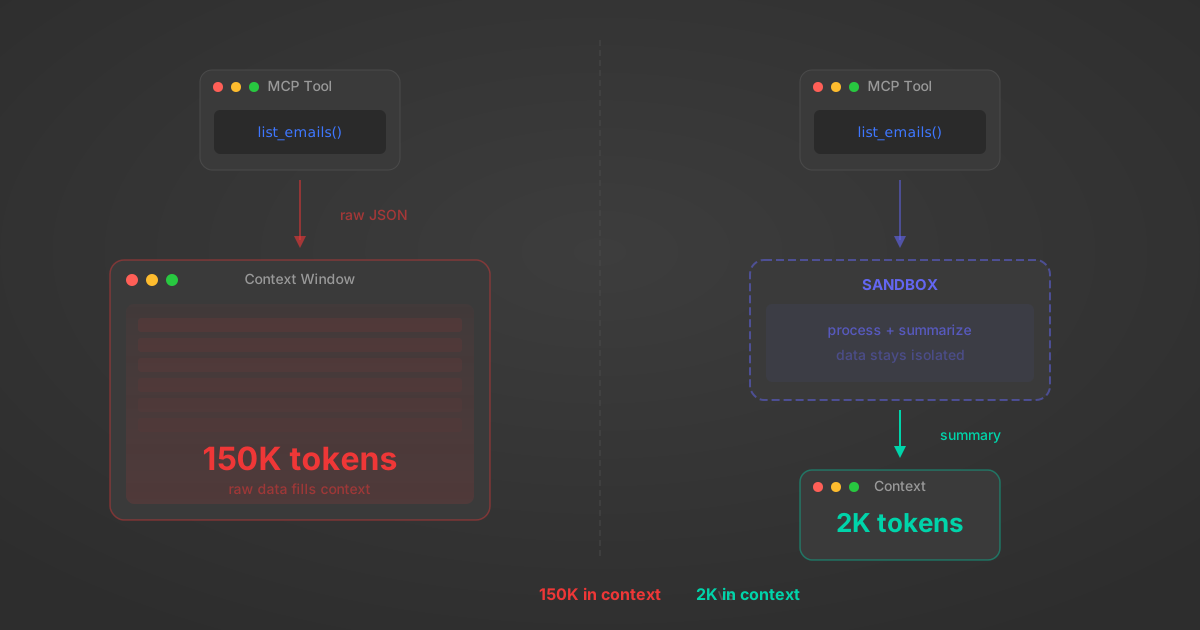
Anthropic's code_execution processes data already in context. Custom MCP code mode keeps raw tool responses in a sandbox. 14K tokens vs 500.
11 min
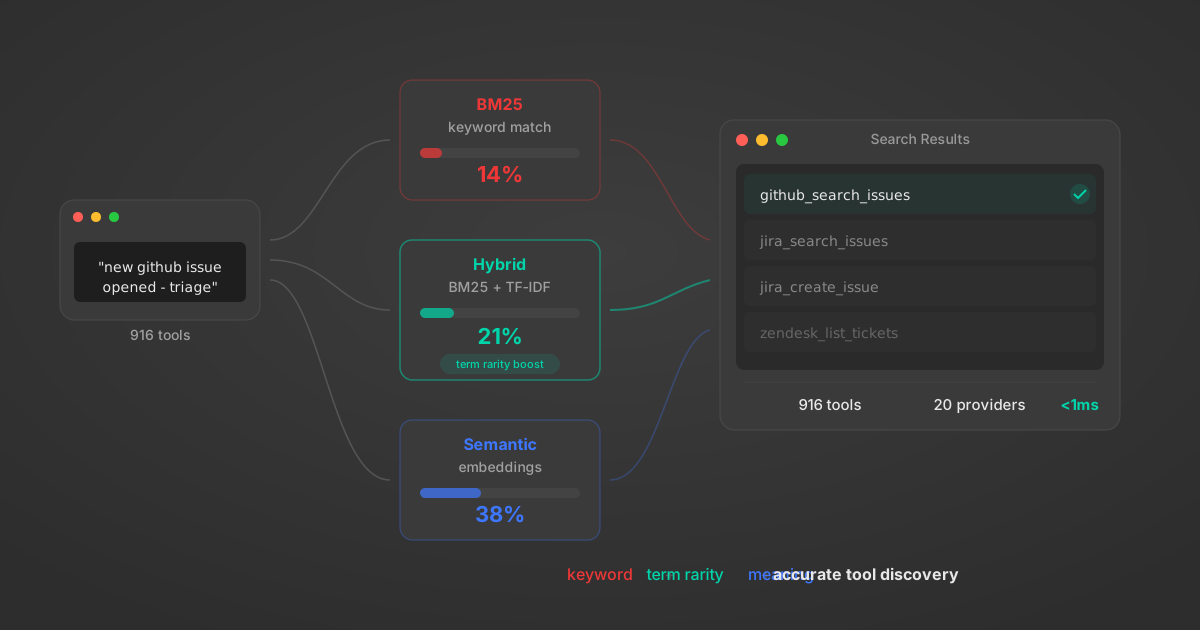
Benchmarking BM25, TF-IDF, and hybrid search for MCP tool discovery across 916 tools. The 80/20 TF-IDF/BM25 hybrid hits 21% Top-1 accuracy in under 1ms.
10 min
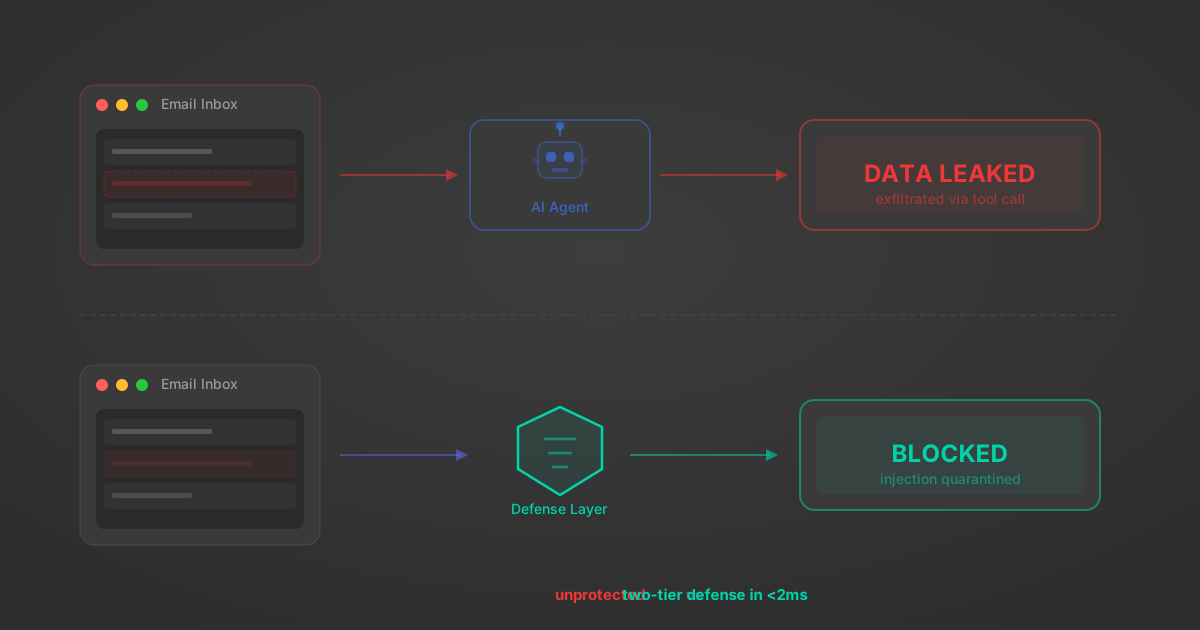
MCP tools that read emails, CRM records, and tickets are indirect prompt injection vectors. Here's how we built a two-tier defense that scans tool results in ~11ms.
12 min
origin_owner_id.All the tools you need to build and scale AI agent integrations, with best-in-class connectivity, execution, and security.