Connect
Optimize
Secure
Announcing StackOne Defender: leading open-source prompt injection guard for your agent • Read More →
Production-ready GitHub MCP server with 83 extensible actions — plus built-in authentication, security, and optimized execution.
 StackOne
Coverage
Create, read, update, and delete across GitHub — and extend your agent's capabilities with custom actions.

Authentication
Per-user OAuth in one call. Your GitHub MCP server gets session-scoped tokens with zero credentials stored on your infra.
Agent Auth →
Security
Every GitHub tool response scanned for prompt injection in milliseconds — 88.7% accuracy, all running on CPU.
Prompt Injection Defense →
Performance
Free up to 96% of your agent's context window to enhance reasoning and reduce cost, on every GitHub call.
Tools Discovery →A GitHub MCP server lets AI agents read and write GitHub data through the Model Context Protocol — Anthropic's open standard for connecting LLMs to external tools. StackOne's GitHub MCP server ships with 83 pre-built actions, fully extensible via the Connector Builder — plus managed authentication, prompt injection defense, and optimized agent context. Connect it from MCP clients like Claude Desktop, Cursor, and VS Code, or from agent frameworks like OpenAI Agents SDK, LangChain, and Vercel AI SDK.
Every action from GitHub's API, ready for your agent. Create, read, update, and delete — scoped to exactly what you need.
Retrieve detailed information about a specific repository
Modify repository settings including name, description, visibility, and features
Permanently remove a repository and all its contents
Retrieve detailed information about a specific organization
Update organization settings and profile information
Create a new issue in a repository
Retrieve issues for a repository with filtering options
Retrieve detailed information about a specific issue
Find issues and pull requests across repositories
Modify issue title, body, labels, assignees, or state
Add a comment to an issue or pull request
Get all comments on an issue
Propose code changes for review and merging
Retrieve pull requests for a repository
Retrieve detailed information about a specific pull request
Modify pull request title, body, or state
Get commit history for a repository or branch
Retrieve detailed information about a specific commit
Get all GitHub users
Retrieve information about a specific user
Modify authenticated user's profile information
Grant repository access to a user
Get all users with access to a repository
Revoke repository access from a user
Retrieve GitHub Actions workflow execution history
Retrieve detailed information about a specific workflow execution (requires run_id from list_workflow_runs)
Get build artifacts generated by workflows
Retrieve artifact files from workflow runs (requires artifact_id from list_artifacts)
Publish a new version of software with release notes
Get all releases for a repository
Modify release details or publish draft releases
Remove a release from the repository
Set up HTTP callbacks for repository events
Get all webhooks configured for a repository
Record a deployment event
Get deployment history for a repository
Remove a deployment record from the repository
Create a new Git reference (branch or tag) pointing to a specific commit SHA
Retrieve a single Git reference by its exact fully-qualified name
Update an existing Git reference to point to a new commit SHA
Delete a Git reference (branch or tag) from a repository
Create a new team in an organization
Get all teams in an organization
Retrieve information about a specific team
Modify team settings and properties
Remove a team from an organization
Add a user to a team
Remove a user from a team
Create a new repository for the authenticated user
Create a new repository in an organization
Submit a code review with comments and approval status
Attach binary files to a release
Update the status of a deployment
Create a new file or update an existing file in a repository
Grant team access to a repository
Retrieve list of repositories for the authenticated user
Retrieve list of public repositories for a specific user
Retrieve list of repositories for an organization
Get all forks of a repository
Get all branches in a repository
Retrieve information about a specific branch
Retrieve list of organization memberships for the authenticated user
Retrieve list of public organization memberships for a specific user
List all users who are members of an organization
Get membership details for a user in an organization (requires organization member authentication)
List all organization memberships for the authenticated user with state and role details
Retrieve information about the authenticated user
Get jobs within a workflow run (requires run_id from list_workflow_runs)
Retrieve the most recent published release
Find code across GitHub repositories
Find repositories matching criteria
Get security vulnerabilities detected by code scanning
Get exposed secrets detected in repository
Get vulnerability alerts for dependencies
Retrieve file or directory contents from a repository
List Git references in a repository matching a given ref prefix
Delete a file from a repository
Create a personal copy of another repository
Check if a user is a member of an organization (publicly or privately)
Integrate approved changes into the base branch
Stop a running workflow (requires run_id from list_workflow_runs)
Retry a failed or completed workflow (requires run_id from list_workflow_runs)
Manually trigger a workflow run
One endpoint. Any framework. Your agent is talking to GitHub in under 10 lines of code.
MCP Clients
Agent Frameworks

 JSON
JSON{
"mcpServers": {
"stackone": {
"command": "npx",
"args": [
"-y",
"mcp-remote@latest",
"https://api.stackone.com/mcp?x-account-id=<account_id>",
"--header",
"Authorization: Basic <YOUR_BASE64_TOKEN>"
]
}
}
}172+ actions
137+ actions
134+ actions
128+ actions
125+ actions
118+ actions
109+ actions
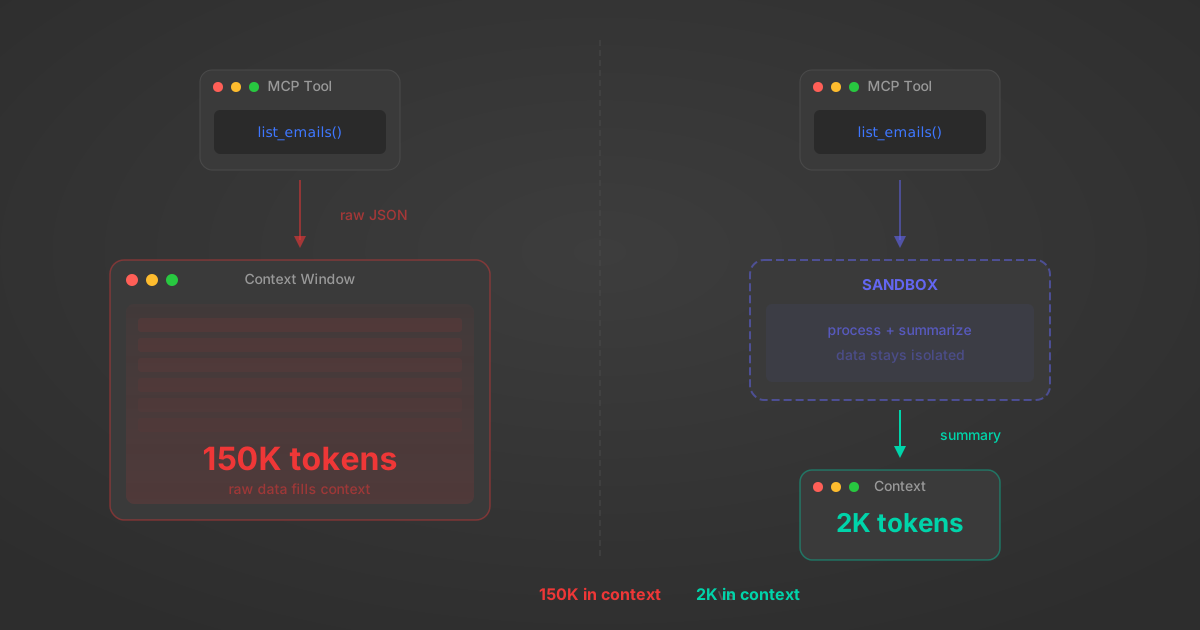
Anthropic's code_execution processes data already in context. Custom MCP code mode keeps raw tool responses in a sandbox. 14K tokens vs 500.
11 min
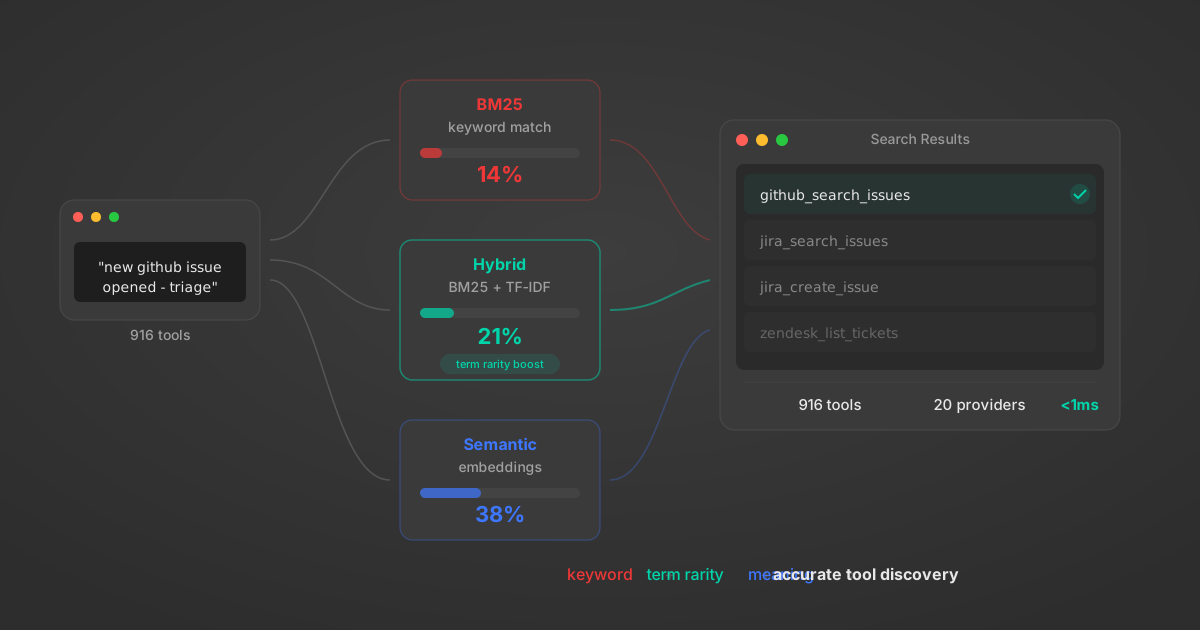
Benchmarking BM25, TF-IDF, and hybrid search for MCP tool discovery across 916 tools. The 80/20 TF-IDF/BM25 hybrid hits 21% Top-1 accuracy in under 1ms.
10 min
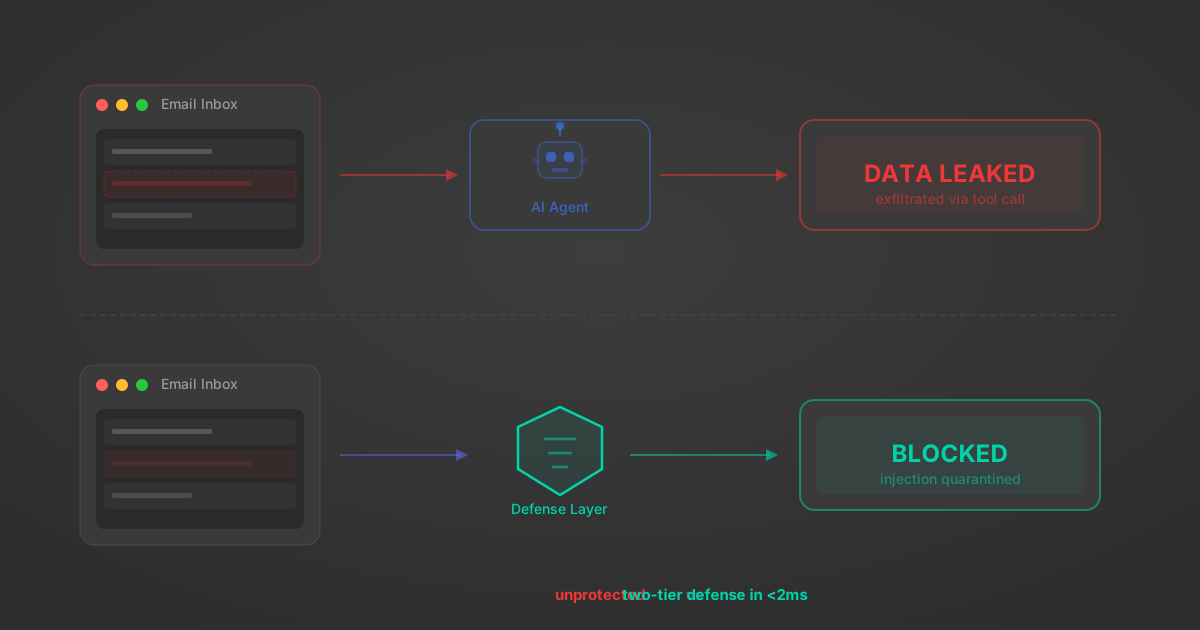
MCP tools that read emails, CRM records, and tickets are indirect prompt injection vectors. Here's how we built a two-tier defense that scans tool results in ~11ms.
12 min
origin_owner_id.All the tools you need to build and scale AI agent integrations, with best-in-class connectivity, execution, and security.