Connect
Optimize
Secure
Announcing StackOne Defender: leading open-source prompt injection guard for your agent • Read More →
Production-ready Harness MCP server with 69 extensible actions — plus built-in authentication, security, and optimized execution.
 StackOne
Coverage
Create, read, update, and delete across Harness — and extend your agent's capabilities with custom actions.

Authentication
Per-user OAuth in one call. Your Harness MCP server gets session-scoped tokens with zero credentials stored on your infra.
Agent Auth →
Security
Every Harness tool response scanned for prompt injection in milliseconds — 88.7% accuracy, all running on CPU.
Prompt Injection Defense →
Performance
Free up to 96% of your agent's context window to enhance reasoning and reduce cost, on every Harness call.
Tools Discovery →A Harness MCP server lets AI agents read and write Harness data through the Model Context Protocol — Anthropic's open standard for connecting LLMs to external tools. StackOne's Harness MCP server ships with 69 pre-built actions, fully extensible via the Connector Builder — plus managed authentication, prompt injection defense, and optimized agent context. Connect it from MCP clients like Claude Desktop, Cursor, and VS Code, or from agent frameworks like OpenAI Agents SDK, LangChain, and Vercel AI SDK.
Every action from Harness's API, ready for your agent. Create, read, update, and delete — scoped to exactly what you need.
Create a new Feature Flags SDK API key for an environment. Use Server keys for backend SDKs and Client keys for frontend or mobile SDKs.
Retrieve all Feature Flags SDK API keys for a specific environment, including their type, name, and metadata.
Retrieve detailed metadata for a specific SDK API key, including its type, name, and expiration status.
Delete an SDK API key, immediately revoking access for all Feature Flag SDKs that use it.
Create a new environment in a project to serve as a deployment target for feature flag targeting and release management.
Retrieve a paginated list of all environments in a project, providing the environment identifiers needed for feature flag and deployment actions.
Retrieve full details for a specific environment by its identifier, including name, type, tags, and configuration metadata.
Update an existing environment by replacing all fields. Provide complete values for every field, not just the ones being changed, as this is a full replacement operation.
Delete an environment from a project, permanently removing all environment-specific feature flag states, targeting rules, and variation maps.
Create a new feature flag in a project with specified variations, kind, and default serving behavior.
Retrieve all feature flags for a project with optional filtering by name, kind, status, and pagination support.
Retrieve a single feature flag by identifier with full configuration details including variations, targeting rules, and environment state.
Modify a feature flag using instruction-based patching to toggle state, update targeting rules, add targets to variations, or change serving configuration.
Delete a feature flag by identifier, removing it from the project and all SDK evaluations.
Retrieve a paginated list of pending invitations at account, organization, or project scope, showing who has been invited but has not yet accepted.
Retrieve a single pending invitation by its invite ID, returning the full invite details including email, role bindings, invite type, and approval status.
Delete a pending invitation by its identifier, permanently canceling the invitation so the invitee can no longer accept it.
Create a new organization in the Harness account with a unique identifier, name, and optional description and tags.
Retrieve a paginated list of all organizations accessible under the authenticated account, with optional filtering by identifiers, search term, and sort order.
Retrieve the full details of a single organization by its unique identifier, including name, description, tags, and metadata.
Replace all fields of an existing organization. Provide values for every field, not just the fields being changed, as this performs a full replacement.
Permanently delete an organization and all its contained resources, including projects, feature flags, targets, and segments.
Create a new project within an organization to serve as a container for feature flags, targets, segments, and other module resources.
Retrieve a paginated list of all projects the authenticated user is a member of, with optional filtering by organization, module type, and search term.
Retrieve the full details of a specific project by its unique identifier, including enabled modules, color, and tags.
Update an existing project by replacing all fields. Provide the complete project object with every field, not just the changed ones.
Permanently delete a project and all its contained resources including feature flags, targets, segments, and environments. This action is irreversible.
Assign a role to a principal (user, user group, or service account) within a resource group at a specific scope, granting that principal the role's permissions.
Retrieve a paginated list of role assignments at a given scope, showing which principals (users, user groups, service accounts) hold which roles on which resource groups.
Retrieve the full details of a single role assignment by its identifier, including the assigned role, resource group, principal, scope, and management flags.
Remove a role assignment, revoking the assigned role's permissions from the principal (user, user group, or service account) at the specified scope.
Create a custom role with specific permissions and allowed scope levels for fine-grained access control.
Retrieve a paginated list of roles with their permissions, scope levels, and assignment counts, with optional filtering by name and management type.
Retrieve the full details of a single role including its permission identifiers, allowed scope levels, and management metadata.
Update a role's name, permissions, scope levels, description, and tags via full replacement. Requires all fields to be provided.
Permanently delete a role by its identifier. Returns the deleted role object on success.
Create a new target group (segment) with explicit target inclusion/exclusion and rule-based targeting clauses for a given project and environment.
Retrieve all target groups (segments) for an environment with optional filtering by name or identifier and configurable sorting and pagination.
Retrieve full details for a specific target group including its included/excluded targets, targeting rules, and version metadata.
Modify a target group using instruction-based patch operations to add or remove included and excluded targets.
Delete a target group (segment) permanently from the specified environment, removing all target associations.
Create a new tag for organizing and categorizing feature flags within a project. Tags are auto-created when attached to feature flags, but this action lets you pre-define them.
Retrieve all tags available for categorizing feature flags in a given project and environment. Supports filtering by tag identifier and pagination.
Retrieve detailed information for a specific tag, including the feature flags associated with it.
Delete a tag and automatically remove it from all feature flags it was associated with.
Create a new feature flag target representing a user, service, or entity for flag evaluation in a specific environment.
Retrieve a paginated list of all feature flag targets for a specific environment, with optional filtering and sorting.
Retrieve the full details for a specific target, including its custom attributes and associated segments.
Permanently remove a target from the environment, stopping all feature flag evaluations for this target.
Create a new user group at account, organization, or project scope with optional initial members, notification channels, and SSO linking.
Retrieve a paginated list of user groups at account, organization, or project scope, with optional filtering by name, scope inheritance, and SSO group linkage.
Retrieve the full details of a single user group by its identifier, including the member user list, notification configurations, and SSO linking status.
Update an existing user group via full replacement (PUT). All fields must be provided, not just the changed ones -- omitted optional fields will be cleared.
Permanently delete a user group by its identifier. Member users are not deleted from the account.
Invite one or more users to the account, organization, or project by email address, with optional role bindings and user group assignments at time of invitation.
Retrieve a paginated list of users in the account, organization, or project scope, with optional filtering by name, email, specific UUIDs, and parent scope inheritance.
Retrieve a single user's full profile and role assignments by UUID, including every role binding with its resource group, scope level, and management flags.
Update a user's profile information by replacing the full user object. Always call get_user first to retrieve current values, then modify and submit all fields.
Remove a user from the specified account, organization, or project scope, revoking all their role assignments and access at that scope without deleting their Harness account.
Add a single user to an existing user group by their user UUID and group identifier. The user inherits all role assignments associated with the group.
Retrieve all feature flags that depend on the specified flag as a prerequisite.
Retrieve a paginated list of pending (not yet accepted) user invitations with aggregated role assignment details, with optional filtering by name, email, role, and resource group.
Retrieve all feature flags that reference the specified target group in their targeting rules.
Retrieve all target groups (segments) that a specific target belongs to, including both explicit and rule-based memberships.
Retrieve users enriched with their role assignment metadata, including role names, resource groups, scope levels, and management flags, with optional filtering by role or resource group.
Remove a single user from a user group by their user UUID and group identifier. The user's individual role assignments are not affected.
Restore a previously deleted feature flag back to active state with its original configuration.
Resend the invitation email for a pending invite that has not yet been accepted, optionally updating the invite's role bindings and user group assignments.
Perform a full replacement update of a target, replacing its name, attributes, and all associations.
One endpoint. Any framework. Your agent is talking to Harness in under 10 lines of code.
MCP Clients
Agent Frameworks

 JSON
JSON{
"mcpServers": {
"stackone": {
"command": "npx",
"args": [
"-y",
"mcp-remote@latest",
"https://api.stackone.com/mcp?x-account-id=<account_id>",
"--header",
"Authorization: Basic <YOUR_BASE64_TOKEN>"
]
}
}
}172+ actions
137+ actions
134+ actions
128+ actions
125+ actions
118+ actions
109+ actions
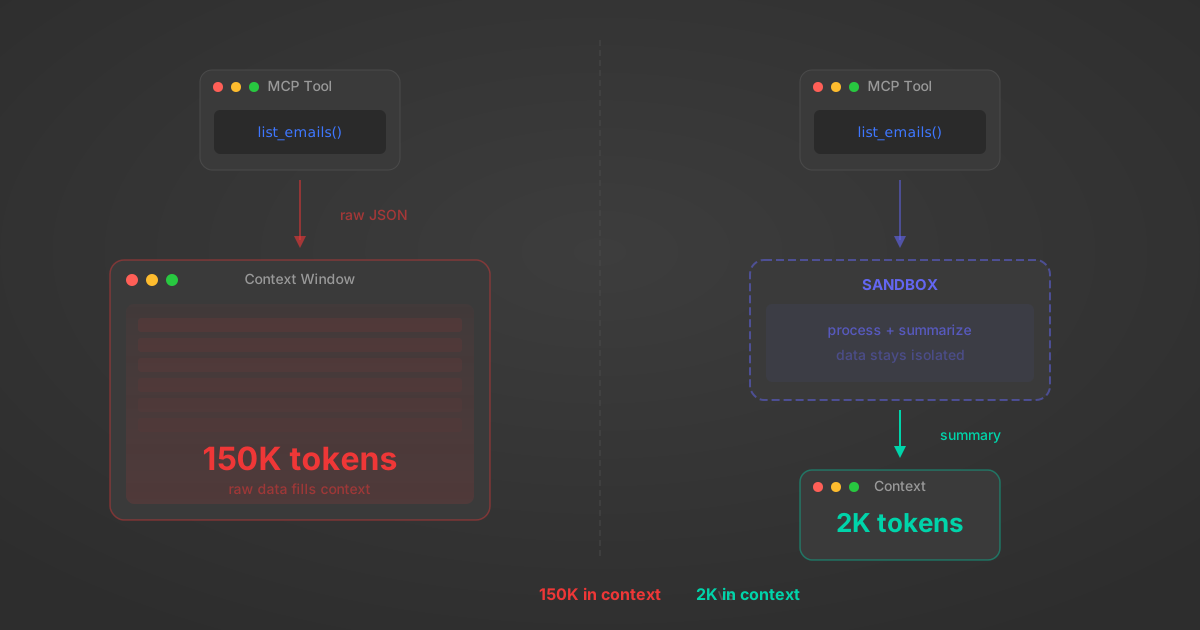
Anthropic's code_execution processes data already in context. Custom MCP code mode keeps raw tool responses in a sandbox. 14K tokens vs 500.
11 min
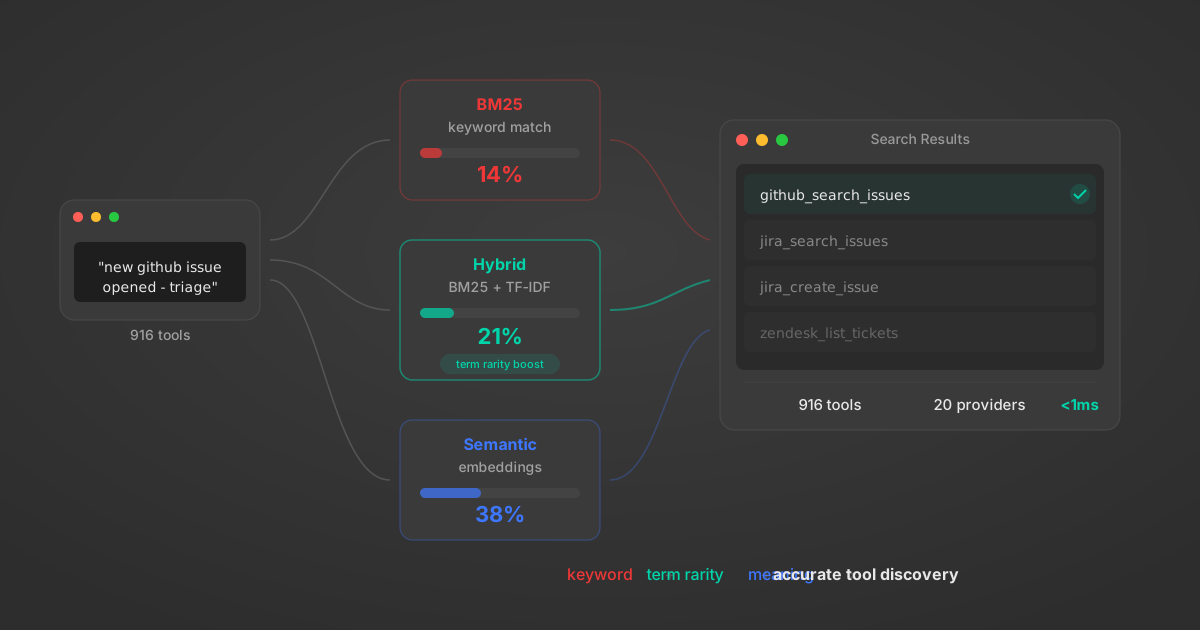
Benchmarking BM25, TF-IDF, and hybrid search for MCP tool discovery across 916 tools. The 80/20 TF-IDF/BM25 hybrid hits 21% Top-1 accuracy in under 1ms.
10 min
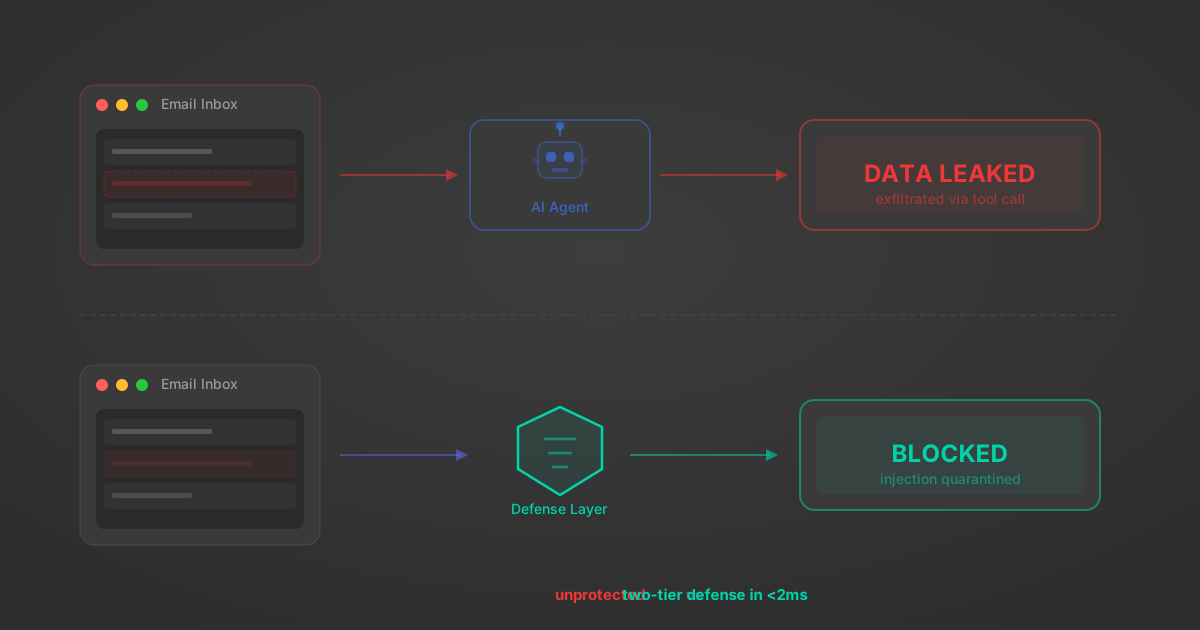
MCP tools that read emails, CRM records, and tickets are indirect prompt injection vectors. Here's how we built a two-tier defense that scans tool results in ~11ms.
12 min
origin_owner_id.All the tools you need to build and scale AI agent integrations, with best-in-class connectivity, execution, and security.