Connect
Optimize
Secure
Announcing StackOne Defender: leading open-source prompt injection guard for your agent • Read More →
Production-ready Plaid MCP server with 30 extensible actions — plus built-in authentication, security, and optimized execution.
 StackOne
Coverage
Create, read, update, and delete across Plaid — and extend your agent's capabilities with custom actions.

Authentication
Per-user OAuth in one call. Your Plaid MCP server gets session-scoped tokens with zero credentials stored on your infra.
Agent Auth →
Security
Every Plaid tool response scanned for prompt injection in milliseconds — 88.7% accuracy, all running on CPU.
Prompt Injection Defense →
Performance
Free up to 96% of your agent's context window to enhance reasoning and reduce cost, on every Plaid call.
Tools Discovery →A Plaid MCP server lets AI agents read and write Plaid data through the Model Context Protocol — Anthropic's open standard for connecting LLMs to external tools. StackOne's Plaid MCP server ships with 30 pre-built actions, fully extensible via the Connector Builder — plus managed authentication, prompt injection defense, and optimized agent context. Connect it from MCP clients like Claude Desktop, Cursor, and VS Code, or from agent frameworks like OpenAI Agents SDK, LangChain, and Vercel AI SDK.
Every action from Plaid's API, ready for your agent. Create, read, update, and delete — scoped to exactly what you need.
Create an Asset Report for the linked Item, providing a point-in-time snapshot of account balances, transactions, and identity data for lending and verification via POST /asset_report/create
Retrieve a completed Asset Report containing account balances, transaction history, and identity data via POST /asset_report/get
Permanently delete an Asset Report and invalidate its token via POST /asset_report/remove
Retrieve a paginated list of all Plaid-supported financial institutions with filtering by country, products, and routing numbers via POST /institutions/get
Search Plaid's institution directory by name or query string with optional product and country filters via POST /institutions/search
Retrieve metadata and health status for a linked financial institution Item via POST /item/get
Permanently remove a linked Item, invalidating its access_token and ending all associated billing via POST /item/remove
Create a link_token to initialize Plaid Link, the client-side UI component for bank account connection, via POST /link/token/create
Retrieve metadata and configuration details for a previously created link_token via POST /link/token/get
Retrieve a list of available bank statements for all accounts linked to an Item via POST /statements/list
Download a single bank statement PDF by its statement ID via POST /statements/download
Fetch historical transaction data within a specified date range with pagination and optional enrichment fields via POST /transactions/get
Get incremental transaction updates using Plaid's recommended cursor-based sync approach, returning added, modified, and removed transactions since the last sync via POST /transactions/sync
Retrieve all financial accounts (checking, savings, credit, loan, investment) linked to an Item via POST /accounts/get
Fetch real-time balance data directly from the financial institution for all or specific accounts via POST /accounts/balance/get
Download a completed Asset Report as a formatted PDF document for sharing with lenders and verifiers via POST /asset_report/pdf/get
Retrieve bank account numbers and routing numbers needed to initiate ACH, EFT, BACS, and wire transfers via POST /auth/get
Retrieve personal identity information (name, email, phone, address) for account holders directly from the financial institution via POST /identity/get
Retrieve detailed metadata for a single financial institution by its Plaid institution_id via POST /institutions/get_by_id
Retrieve current investment portfolio holdings including stocks, bonds, mutual funds, and ETFs for linked brokerage and retirement accounts via POST /investments/holdings/get
Retrieve investment transactions (buys, sells, dividends, fees, transfers) within a specified date range for linked brokerage accounts via POST /investments/transactions/get
Retrieve detailed liabilities data for credit cards, student loans, and mortgages associated with an Item via POST /liabilities/get
Fetch Plaid-detected recurring transaction patterns (subscriptions, income deposits, bills) for accounts associated with an Item via POST /transactions/recurring/get
Update or set the webhook URL for receiving real-time event notifications for an Item via POST /item/webhook/update
Create a refreshed copy of an existing Asset Report with updated data from the financial institutions via POST /asset_report/refresh
Create a filtered copy of an Asset Report with specified accounts excluded via POST /asset_report/filter
Exchange a single-use public_token for a permanent access_token via POST /item/public_token/exchange
Create a test public_token for a sandbox Item, simulating the Plaid Link flow without user interaction, via POST /sandbox/public_token/create
Trigger on-demand extraction of bank statements for a specified date range via POST /statements/refresh
Trigger an on-demand refresh of transaction data for an Item, bypassing the normal automatic update schedule, via POST /transactions/refresh
One endpoint. Any framework. Your agent is talking to Plaid in under 10 lines of code.
MCP Clients
Agent Frameworks

 JSON
JSON{
"mcpServers": {
"stackone": {
"command": "npx",
"args": [
"-y",
"mcp-remote@latest",
"https://api.stackone.com/mcp?x-account-id=<account_id>",
"--header",
"Authorization: Basic <YOUR_BASE64_TOKEN>"
]
}
}
}118+ actions
104+ actions
95+ actions
71+ actions
70+ actions
57+ actions
15+ actions
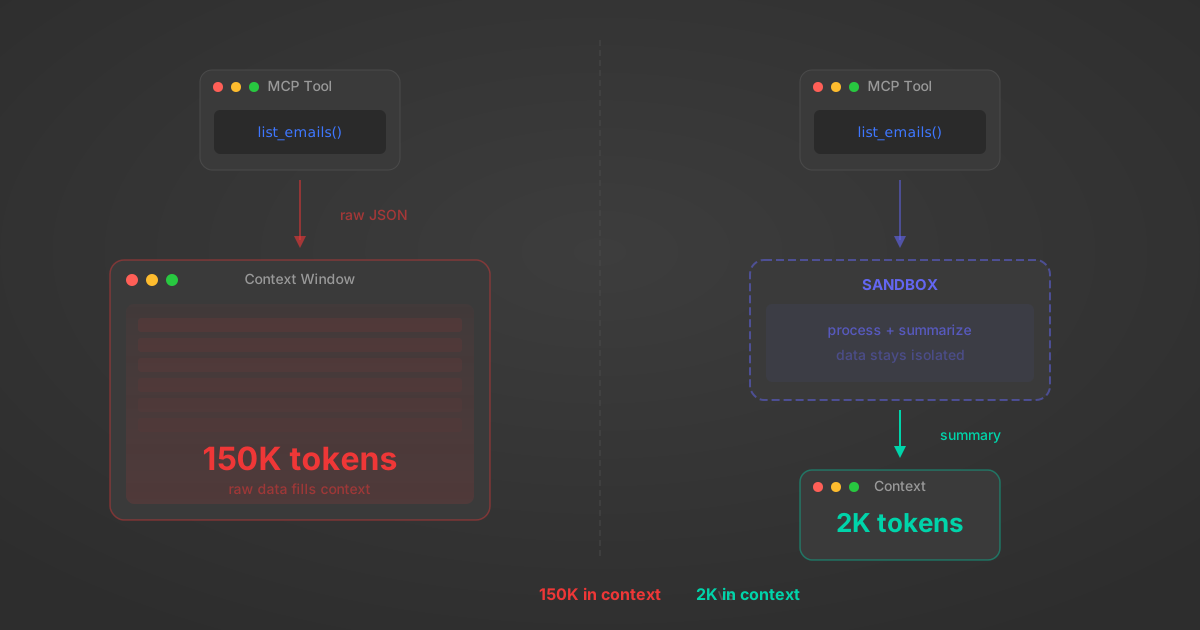
Anthropic's code_execution processes data already in context. Custom MCP code mode keeps raw tool responses in a sandbox. 14K tokens vs 500.
11 min
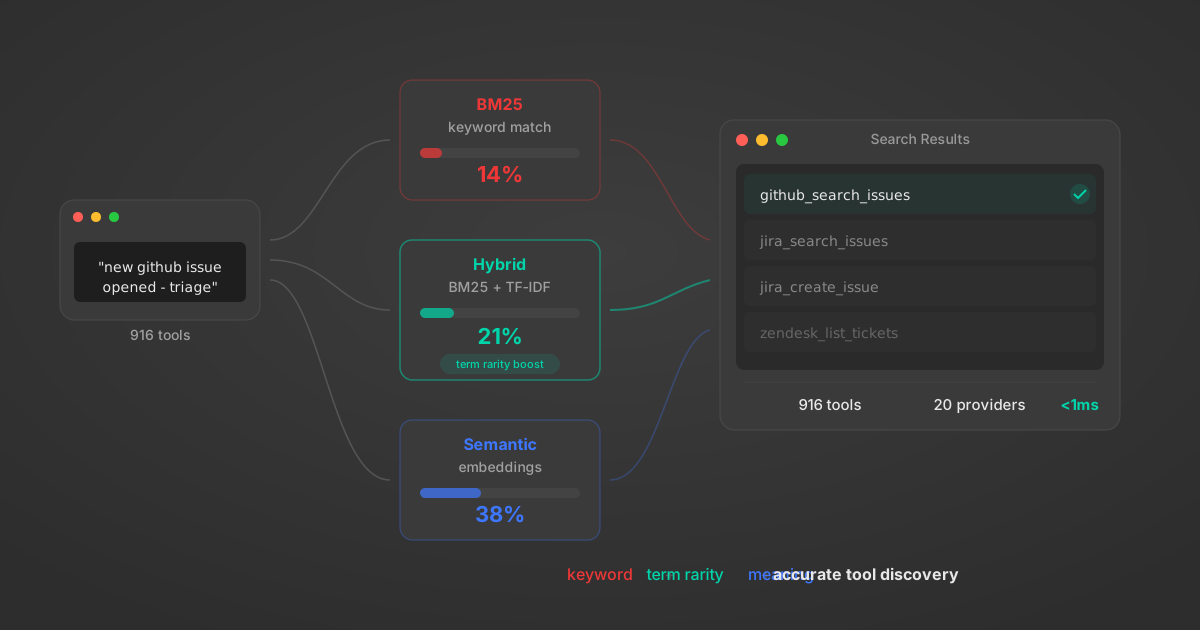
Benchmarking BM25, TF-IDF, and hybrid search for MCP tool discovery across 916 tools. The 80/20 TF-IDF/BM25 hybrid hits 21% Top-1 accuracy in under 1ms.
10 min
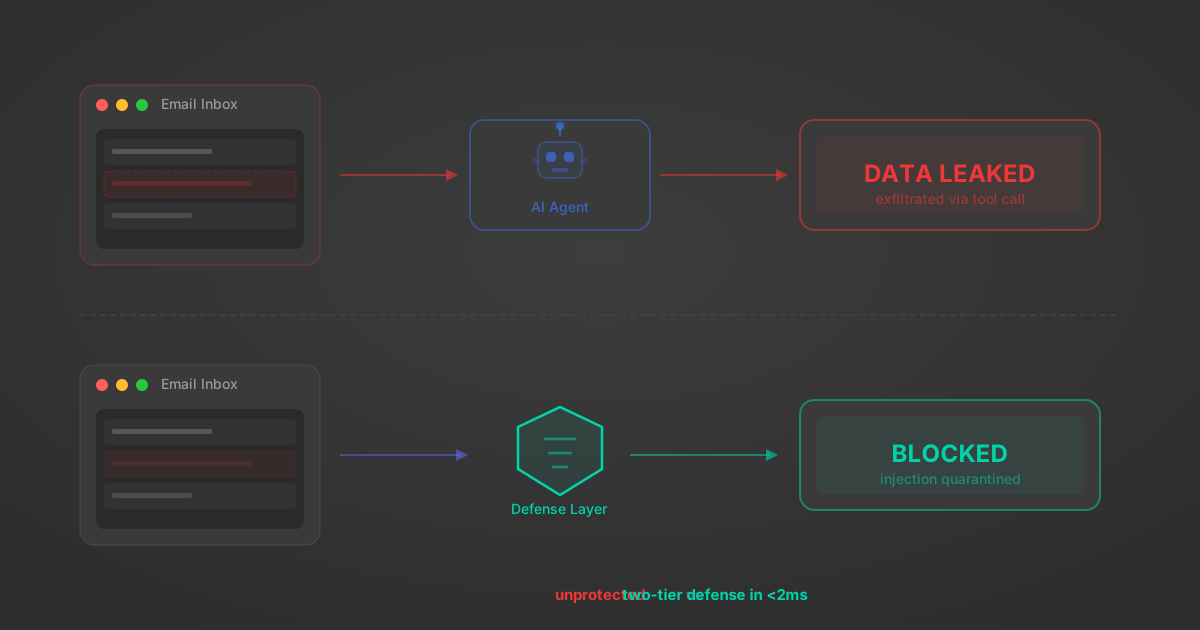
MCP tools that read emails, CRM records, and tickets are indirect prompt injection vectors. Here's how we built a two-tier defense that scans tool results in ~11ms.
12 min
origin_owner_id.All the tools you need to build and scale AI agent integrations, with best-in-class connectivity, execution, and security.