Connect
Optimize
Secure
Announcing StackOne Defender: leading open-source prompt injection guard for your agent • Read More →
Use StackOne to connect your AI agent to your helpdesk, CRM, and messaging tools to automate SLA breach prediction and escalation.



AI Agents
MCP and A2A to REST, SOAP, and proprietary APIs.
Tool discovery, data shaping, and reliable execution.
Scoped permissions, audit trails, and observability.
StackOne Integration Layer


 StackOne Integration Layer
200+ connectors, build your own, and multi-protocol support.
Context, token, and speed optimization infrastructure.
Permissions API and prompt injection protection.
Your agent monitors every open ticket, calculates breach risk, enriches with customer context, and escalates before violations occur.
Pull SLA targets — first response, resolution time, update frequency — per priority and tier from Zendesk, Freshdesk, or ServiceNow.
Subscribe to ticket events via webhooks. Calculate SLA burn rate and remaining buffer in business hours for every open ticket across connected helpdesks.
Assess breach risk using agent workload, average handle time, queue depth, and agent availability. Flag tickets likely to miss their SLA target.
Look up account tier, contract value, and CSAT scores from Salesforce or HubSpot to factor business impact into escalation decisions.
Send warnings to the assigned agent via Slack. Escalate to the team lead if no action. Auto-reassign to available agents when the breach window closes.
Record every escalation action for audit. After resolution, calculate SLA performance vs. target and update historical metrics for continuous improvement.
Pull SLA targets — first response, resolution time, update frequency — per priority and tier from Zendesk, Freshdesk, or ServiceNow.
Subscribe to ticket events via webhooks. Calculate SLA burn rate and remaining buffer in business hours for every open ticket across connected helpdesks.
Assess breach risk using agent workload, average handle time, queue depth, and agent availability. Flag tickets likely to miss their SLA target.
Look up account tier, contract value, and CSAT scores from Salesforce or HubSpot to factor business impact into escalation decisions.
Send warnings to the assigned agent via Slack. Escalate to the team lead if no action. Auto-reassign to available agents when the breach window closes.
Record every escalation action for audit. After resolution, calculate SLA performance vs. target and update historical metrics for continuous improvement.
An SLA prediction agent needs to read tickets from Zendesk, Freshdesk, or ServiceNow, pull account context from Salesforce or HubSpot, and push alerts to Slack. Building and maintaining connectors for each — OAuth scopes, cursor-based pagination, per-provider rate limits — is a massive lift.
Without search-first architecture, the agent pre-loads every helpdesk and CRM action definition into its context window. At hundreds of open tickets per day, that burns tokens on irrelevant tools before the agent even starts predicting breaches.
SLA agents ingest unstructured ticket descriptions, internal notes, and customer replies. Any of those fields can contain adversarial instructions that hijack agent behavior — a risk that grows with every ticket the agent processes.
Predicting SLA breaches requires reading ticket priority, assignment history, and resolution timestamps in a single call. Raw helpdesk API wrappers expose too many low-level details, lead to hallucinated parameters, and fail silently.
Everything your SLA prediction agent needs to monitor tickets, enrich with CRM data, and trigger escalations — with the controls IT demands.
Pre-built connectors for Zendesk, Freshdesk, ServiceNow, Intercom, Salesforce, HubSpot, and Slack with full native action coverage and agent instructions included.
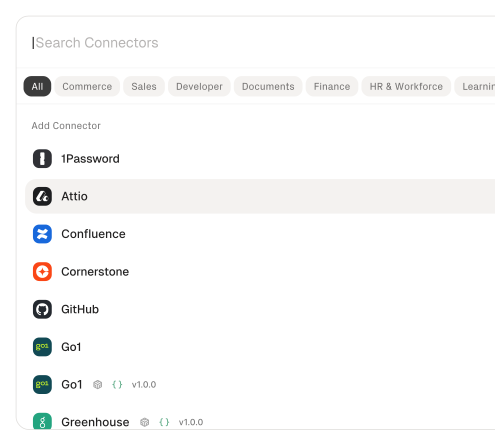
OAuth flows, API keys, and token refresh managed per tenant for every connected helpdesk and CRM — agents never touch raw credentials.
Agent searches StackOne's action catalog by natural language and executes the matching helpdesk or CRM action — no pre-loading thousands of tool definitions.
StackOne subscribes to ticket lifecycle events across connected helpdesks, handling registration, retries, and delivery differences so the agent receives a consistent event stream.
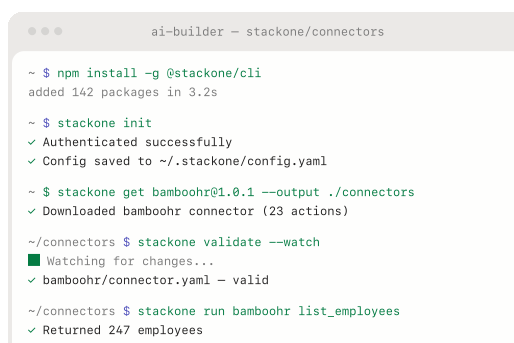
Build custom connectors for unsupported helpdesks or internal escalation systems via REST, SOAP, or GraphQL — no waiting on vendor support.
StackOne Defender screens inbound ticket text for injection attempts before the agent processes it, preventing adversarial content from manipulating escalation behavior.
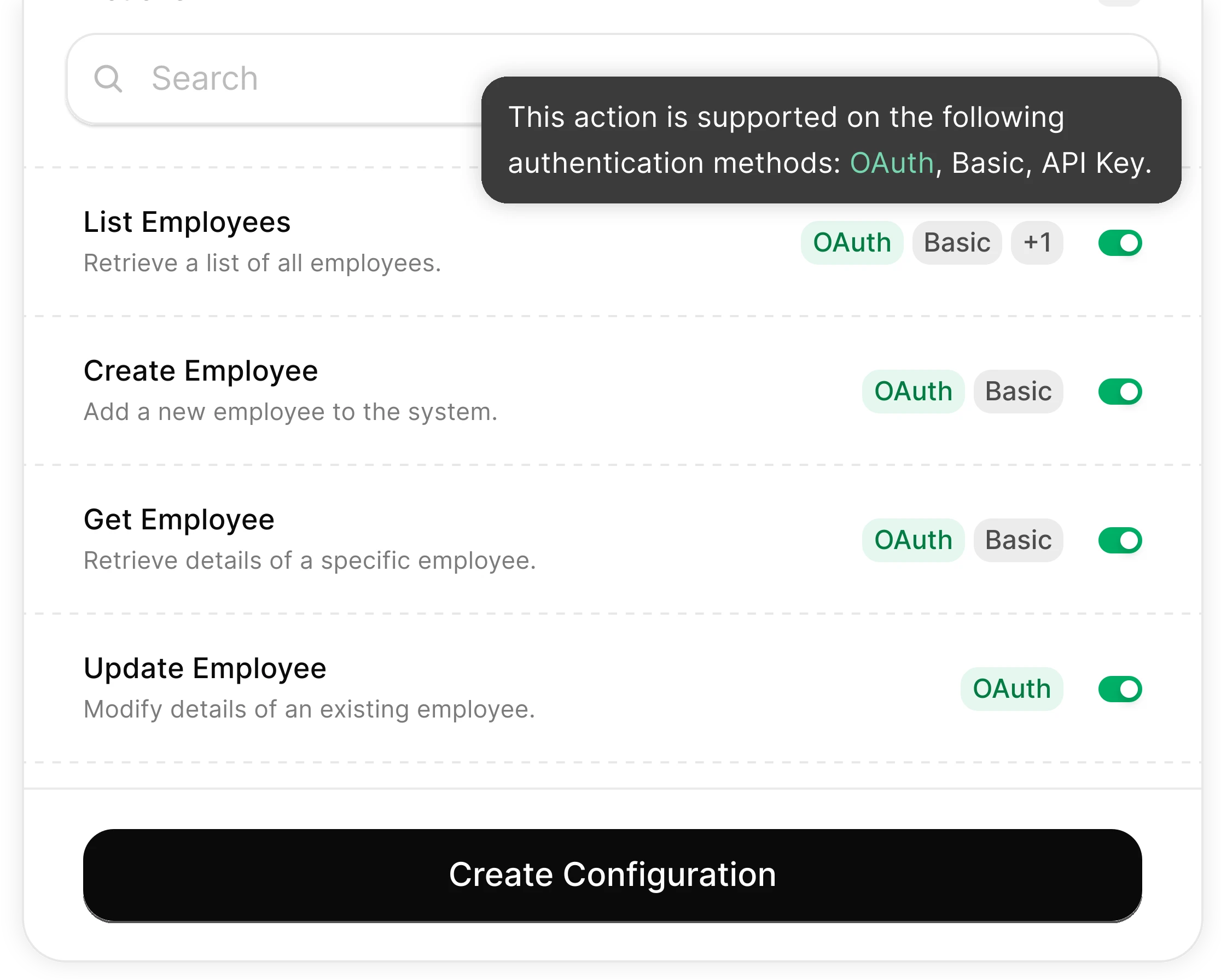
Scoped permissions define exactly which ticket fields the agent reads and which escalation actions it can trigger. Full audit trail of every operation.

Claude, OpenAI, LangChain, Vercel AI SDK, CrewAI, Pydantic AI — StackOne works with every major agent framework out of the box.


Whether you're building with code, a visual builder, or an enterprise platform — StackOne provides the integration layer your agent needs.
Start building in minutes. MCP connectors to every system your agent needs.
Use StackOne to connect your AI agent to your helpdesk, CRM, and messaging tools to automate ticket triage and priority routing.
View →Use StackOne to connect your AI agent to your telephony, CRM, and messaging tools to automate voice call summarization and CRM logging.
View →Use StackOne to connect your AI agent to your helpdesk, survey tools, and CRM to automate CSAT/NPS follow-up and detractor recovery.
View →Use StackOne to connect your AI agent to your CRM, project management, and messaging tools to automate customer onboarding.
View →Use StackOne to connect your AI agent to your helpdesk, payment processor, and e-commerce platform to automate refund and return processing.
View →
Start building in minutes. MCP connectors to every system your agent needs.