Connect
Optimize
Secure
Announcing StackOne Defender: leading open-source prompt injection guard for your agent • Read More →
Production-ready Google Sheets MCP server with extensible actions — plus built-in authentication, security, and optimized execution.
 StackOne
Coverage
Create, read, update, and delete across Google Sheets — and extend your agent's capabilities with custom actions.

Authentication
Per-user OAuth in one call. Your Google Sheets MCP server gets session-scoped tokens with zero credentials stored on your infra.
Agent Auth →
Security
Every Google Sheets tool response scanned for prompt injection in milliseconds — 88.7% accuracy, all running on CPU.
Prompt Injection Defense →
Performance
Free up to 96% of your agent's context window to enhance reasoning and reduce cost, on every Google Sheets call.
Tools Discovery →A Google Sheets MCP server lets AI agents read and write Google Sheets data through the Model Context Protocol — Anthropic's open standard for connecting LLMs to external tools. StackOne's Google Sheets MCP server ships with pre-built actions, fully extensible via the Connector Builder — plus managed authentication, prompt injection defense, and optimized agent context. Connect it from MCP clients like Claude Desktop, Cursor, and VS Code, or from agent frameworks like OpenAI Agents SDK, LangChain, and Vercel AI SDK.
Every action from Google Sheets's API, ready for your agent. Create, read, update, and delete — scoped to exactly what you need.
Creates a spreadsheet, returning the newly created spreadsheet.
Returns the spreadsheet at the given ID. The caller must specify the spreadsheet ID.
Applies one or more updates to the spreadsheet. Each request is validated before being applied. If any request is not valid then the entire request will fail and nothing will be applied. Some requests have replies to give you some information about how they are applied. The replies will mirror the requests. For example, if you applied 4 updates and the 3rd one had a reply, then the response will have 2 empty replies, the actual reply, and another empty reply, in that order. Due to the collaborative nature of spreadsheets, it is not guaranteed that the spreadsheet will reflect exactly your changes after this completes, however it is guaranteed that the updates in the request will be applied together atomically. Your changes may be altered with respect to collaborator changes. If there are no collaborators, the spreadsheet should reflect your changes.
Returns the spreadsheet at the given ID. The caller must specify the spreadsheet ID. This method differs from spreadsheets.get in that it allows selecting which subsets of spreadsheet data to return by specifying a dataFilters parameter. Multiple DataFilters can be specified. Specifying one or more data filters returns the portions of the spreadsheet that intersect ranges matched by any of the filters.
Appends rows after the last row of a detected table. The range specifies where to search for the table, not where data is written.
Returns a range of values from a spreadsheet. The caller must specify the spreadsheet ID and a range.
Updates a single contiguous range in a spreadsheet. Use Batch Update Values for multiple ranges or better efficiency.
Atomically updates one or more ranges. All succeed or fail together. More efficient than separate calls.
Returns one or more ranges of values from a spreadsheet. The caller must specify the spreadsheet ID and one or more ranges.
Clears one or more ranges of values from a spreadsheet. The caller must specify the spreadsheet ID and one or more ranges. Only values are cleared; all other properties of the cell (such as formatting and data validation) are kept.
Clears values from a spreadsheet. The caller must specify the spreadsheet ID and range. Only values are cleared; all other properties of the cell (such as formatting, data validation, etc.) are kept.
Returns one or more ranges of values that match the specified data filters. The caller must specify the spreadsheet ID and one or more DataFilters. Ranges that match any of the data filters in the request will be returned.
Clears one or more ranges of values from a spreadsheet. The caller must specify the spreadsheet ID and one or more DataFilters. Ranges matching any of the specified data filters will be cleared. Only values are cleared; all other properties of the cell (such as formatting, data validation, etc.) are kept.
Returns the developer metadata with the specified ID. The caller must specify the spreadsheet ID and the developer metadata's unique metadataId.
Returns all developer metadata matching the specified DataFilter. If the provided DataFilter represents a DeveloperMetadataLookup object, this will return all DeveloperMetadata entries selected by it. If the DataFilter represents a location in a spreadsheet, this will return all developer metadata associated with locations intersecting that region.
Copies a single sheet from a spreadsheet to another spreadsheet. Returns the properties of the newly created sheet.
One endpoint. Any framework. Your agent is talking to Google Sheets in under 10 lines of code.
MCP Clients
Agent Frameworks

 JSON
JSON{
"mcpServers": {
"stackone": {
"command": "npx",
"args": [
"-y",
"mcp-remote@latest",
"https://api.stackone.com/mcp?x-account-id=<account_id>",
"--header",
"Authorization: Basic <YOUR_BASE64_TOKEN>"
]
}
}
}114+ actions
104+ actions
101+ actions
100+ actions
80+ actions
63+ actions
53+ actions
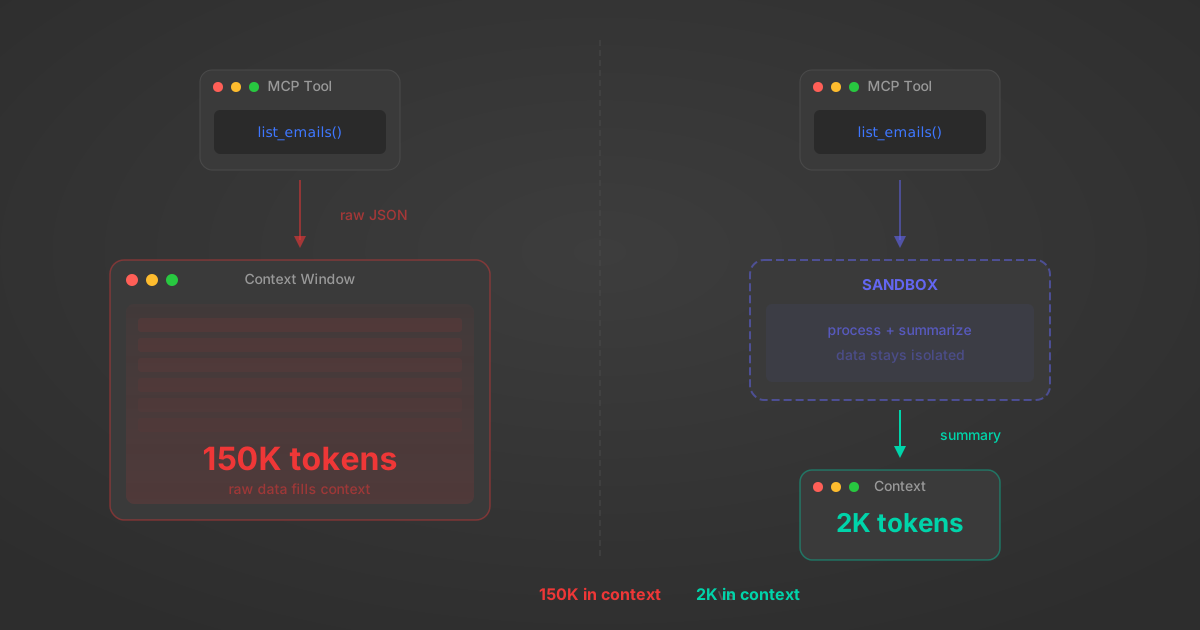
Anthropic's code_execution processes data already in context. Custom MCP code mode keeps raw tool responses in a sandbox. 14K tokens vs 500.
11 min
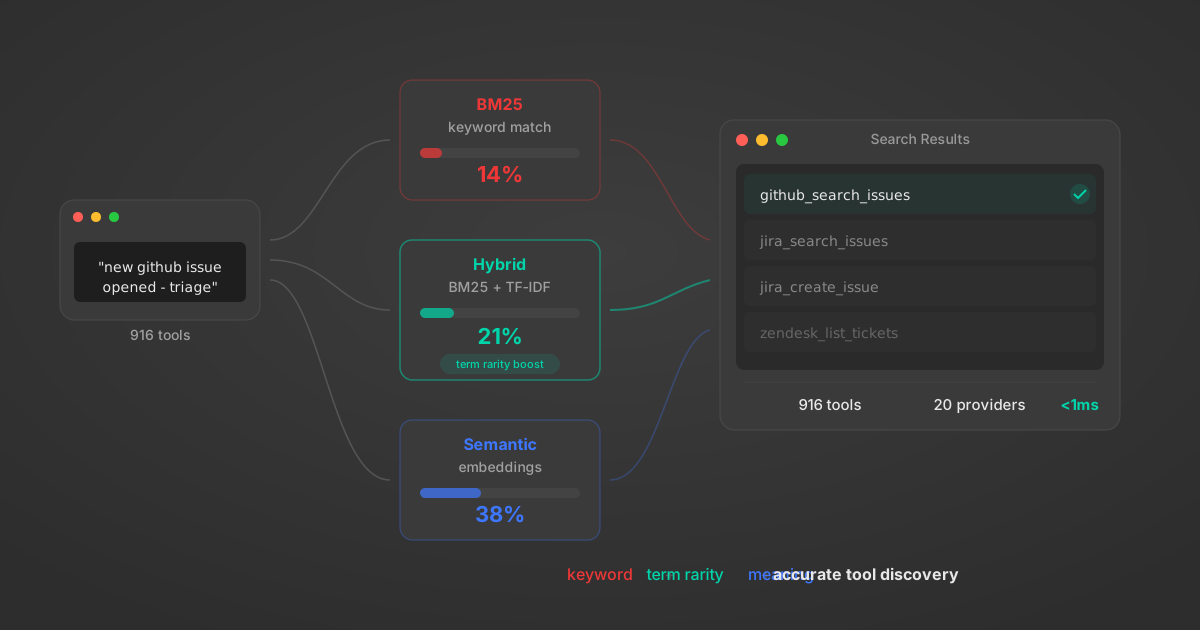
Benchmarking BM25, TF-IDF, and hybrid search for MCP tool discovery across 916 tools. The 80/20 TF-IDF/BM25 hybrid hits 21% Top-1 accuracy in under 1ms.
10 min
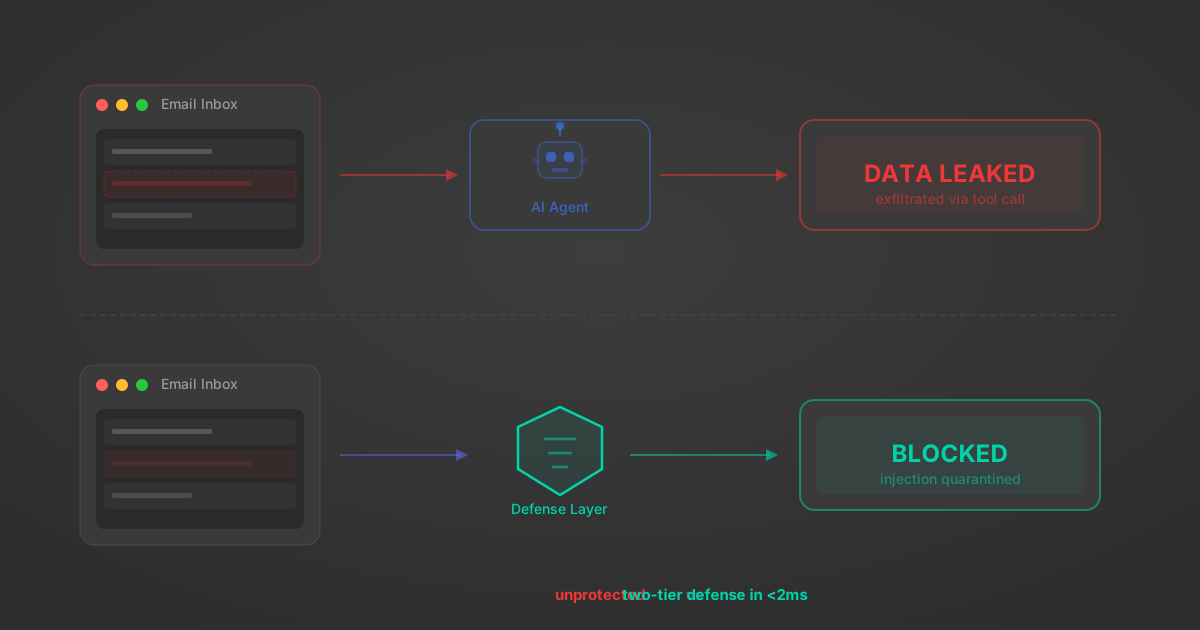
MCP tools that read emails, CRM records, and tickets are indirect prompt injection vectors. Here's how we built a two-tier defense that scans tool results in ~11ms.
12 min
origin_owner_id.All the tools you need to build and scale AI agent integrations, with best-in-class connectivity, execution, and security.