Connect
Optimize
Secure
Announcing StackOne Defender: leading open-source prompt injection guard for your agent • Read More →
Production-ready SharePoint MCP server with extensible actions — plus built-in authentication, security, and optimized execution.
 StackOne
Coverage
Create, read, update, and delete across SharePoint — and extend your agent's capabilities with custom actions.

Authentication
Per-user OAuth in one call. Your SharePoint MCP server gets session-scoped tokens with zero credentials stored on your infra.
Agent Auth →
Security
Every SharePoint tool response scanned for prompt injection in milliseconds — 88.7% accuracy, all running on CPU.
Prompt Injection Defense →
Performance
Free up to 96% of your agent's context window to enhance reasoning and reduce cost, on every SharePoint call.
Tools Discovery →A SharePoint MCP server lets AI agents read and write SharePoint data through the Model Context Protocol — Anthropic's open standard for connecting LLMs to external tools. StackOne's SharePoint MCP server ships with pre-built actions, fully extensible via the Connector Builder — plus managed authentication, prompt injection defense, and optimized agent context. Connect it from MCP clients like Claude Desktop, Cursor, and VS Code, or from agent frameworks like OpenAI Agents SDK, LangChain, and Vercel AI SDK.
Every action from SharePoint's API, ready for your agent. Create, read, update, and delete — scoped to exactly what you need.
Search and retrieve SharePoint sites across the organization using keyword search. This is the primary entry point for discovering sites - use "*" to list all accessible sites or provide specific search terms to find sites by name, description, or content.
Retrieve complete metadata for a specific SharePoint site by its unique identifier, including configuration details, timestamps, and optionally related resources like document libraries and lists. Use this after list_sites to get full site details or to verify site existence before performing operations.
Find SharePoint sites matching a keyword search query with relevance-ranked results. Use this when you have a search term or site name fragment from a user and need to find matching sites. Unlike list_sites, search is required here and results are ordered by relevance rather than alphabetically.
Retrieve all items from a SharePoint list as structured data records with their field values. Supports filtering by column values and selecting specific columns. IMPORTANT - You must use expand=fields to get column data as field values are not included by default.
Retrieve a single item from a SharePoint list by its ID with complete metadata and field values. Use this to get detailed item data before updates, verify item existence, retrieve the web URL for sharing, or get the eTag for optimistic concurrency control.
Retrieve a SharePoint site using its URL hostname and server-relative path instead of an opaque ID. This is the preferred method when you have a SharePoint URL from a user, document link, or browser address bar and need to resolve it to a site resource with its API-usable ID.
Retrieve all immediate child subsites nested under a parent SharePoint site. Use this to navigate site hierarchies, discover departmental or project sites organized under a parent team site, and build site tree structures for navigation interfaces.
Retrieve the tenant's root SharePoint site collection without needing to know its ID. This is the primary entry point for discovering the organization's SharePoint structure, hostname, and top-level sites when starting fresh without prior context.
Retrieve all site column definitions available at the site level for schema discovery. Site columns are reusable metadata field templates that can be added to multiple lists within the site, promoting consistent data schemas across the organization.
Retrieve all content type definitions available at a SharePoint site for understanding document and item templates. Content types bundle metadata columns with settings and behaviors, enabling consistent categorization of documents like contracts, invoices, or project documents across lists and libraries.
Retrieve all SharePoint lists in a site including document libraries, custom data lists, task lists, and system lists. Use this to discover available structured data containers before querying their items or to inventory a site's data assets.
Retrieve detailed metadata for a specific SharePoint list including its template type, content type settings, creation date, and web URL. Use this to verify list existence, get sharing URLs, or understand list configuration before performing data operations.
Retrieve the complete schema of all columns in a SharePoint list including their data types, validation rules, and configuration. Essential for understanding list structure before querying items, building forms, or mapping data fields.
Retrieve the status of long-running background operations on a SharePoint list such as bulk imports, content type synchronization, or schema changes. Use this to monitor async operation progress, identify failed operations, or audit operation history.
Retrieve all document libraries (drives) available in a SharePoint site including their storage quota, ownership, and configuration. Use this to discover available file storage locations before browsing files or uploading documents.
Retrieve detailed metadata for a specific SharePoint document library including current storage quota status, ownership information, and configuration. Use this to check storage availability before uploads, monitor quota usage, or get the shareable web URL.
List all files and folders at the root level of a SharePoint document library. Returns item metadata including name, size, type (file/folder), MIME type, and timestamps. Use list_drive_item_children to browse into subfolders.
List all files and folders within a specific folder in a SharePoint document library. Use this to navigate into subfolders after using list_drive_root_children to browse the root level.
Retrieve complete metadata for a specific file or folder in SharePoint, including size, MIME type, permissions, and sharing links.
One endpoint. Any framework. Your agent is talking to SharePoint in under 10 lines of code.
MCP Clients
Agent Frameworks

 JSON
JSON{
"mcpServers": {
"stackone": {
"command": "npx",
"args": [
"-y",
"mcp-remote@latest",
"https://api.stackone.com/mcp?x-account-id=<account_id>",
"--header",
"Authorization: Basic <YOUR_BASE64_TOKEN>"
]
}
}
}133+ actions
101+ actions
92+ actions
67+ actions
47+ actions
44+ actions
39+ actions
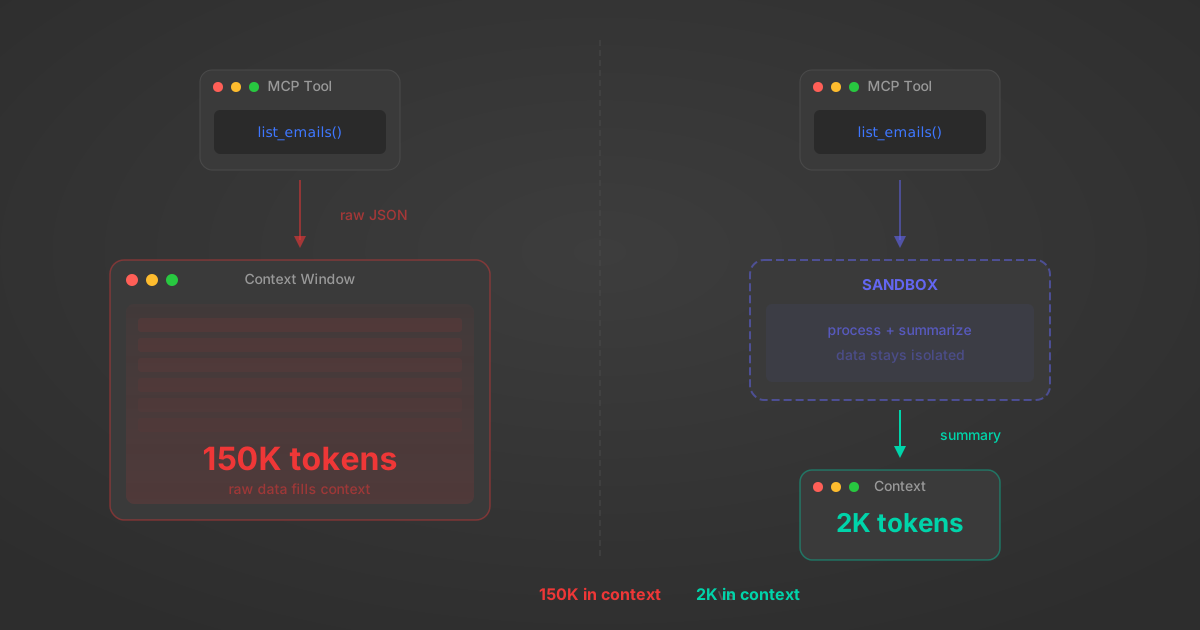
Anthropic's code_execution processes data already in context. Custom MCP code mode keeps raw tool responses in a sandbox. 14K tokens vs 500.
11 min
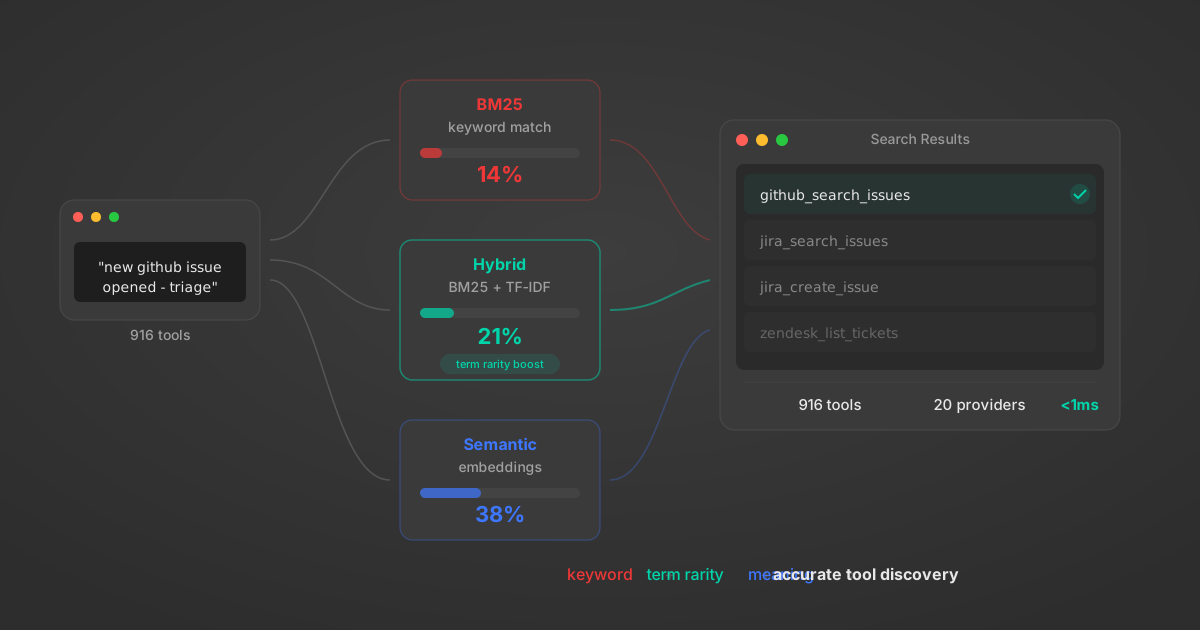
Benchmarking BM25, TF-IDF, and hybrid search for MCP tool discovery across 916 tools. The 80/20 TF-IDF/BM25 hybrid hits 21% Top-1 accuracy in under 1ms.
10 min
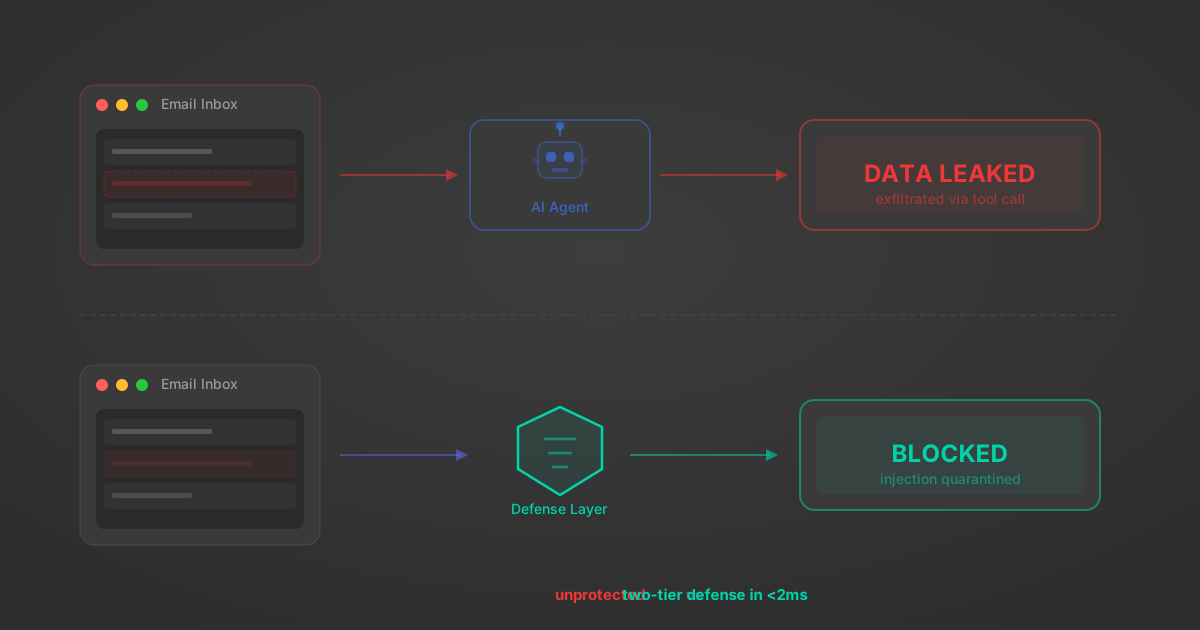
MCP tools that read emails, CRM records, and tickets are indirect prompt injection vectors. Here's how we built a two-tier defense that scans tool results in ~11ms.
12 min
origin_owner_id.All the tools you need to build and scale AI agent integrations, with best-in-class connectivity, execution, and security.